 By
By I find most end-of-year prediction and crystal ball-gazing listicles to be trash. They don’t prove their assertions, use anecdotes rather than data at scale to back up their prognostications, and, worst of all, fail to grade their previous predictions (how the #$%@ else do you know if you can trust their current ones?!). And yes, I’m looking at you, Gartner, Forrester, Inc, and Forbes. None of those publications grade past predictions, yet they somehow receive fawning, breathless, credulous coverage when writing about how AI will take all the jobs by 2023 2024 2025 2026 (reality check: AI was responsible for <5% of US job cuts in 2025), or how Google search is dying (reality check: nope, not even close), or how virtual influencers will replace human ones (reality check: brands investments in AI influencers dropped 30% last year).
If you’re going to trust my predictions, I’ll need to do better (and, cough cough, you’ll need to hold your information sources to a higher standard). Next January, we’ll revisit these and see how I did.
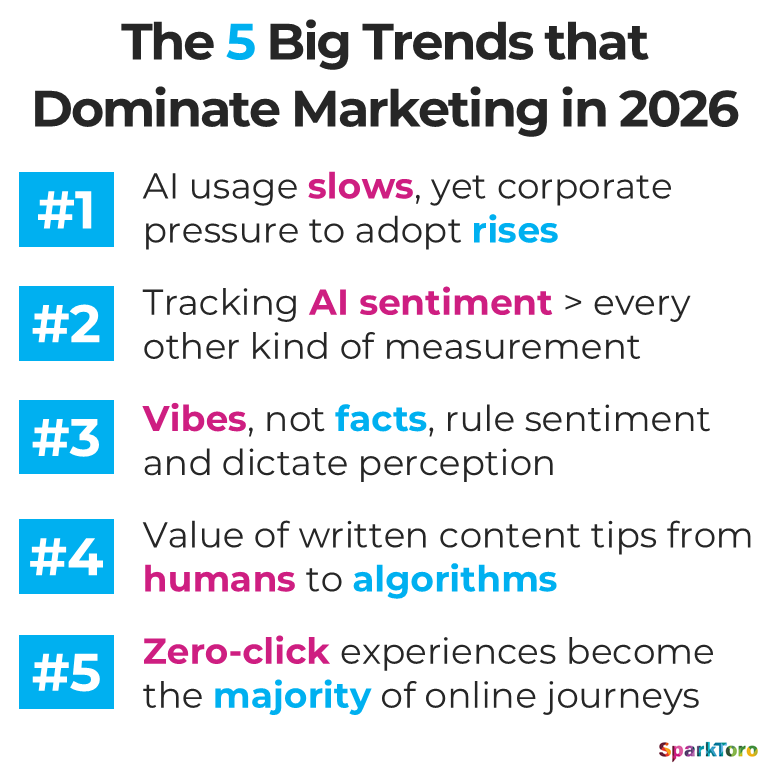
#1: AI usage growth will slow dramatically; pressure on businesses (and employees) to adopt AI will not
If you’ve been following Datos’ State of Search reports, you know that while AI tool adoption continues to rise, the rate of growth is slowing. Unless there’s a dramatic upswing, we can expect that AI tool usage will plateau with lower rates of use than social media, search engines, messaging apps, or e-commerce.

But, I’m convinced this will have little impact on the passionate fervor corporate leaders show for AI use within their organizations. Teams that build AI into internal tools will earn have at least another year of investment untethered to metrics or ROI. Employees that do things with AI will have perception-based advantages over their AI-skeptical peers (even when the latter is fully justified). There will be pressure to trim headcount in non-AI-centric parts of organizations, while vast budgets are devoted to AI transformation.
In other words, 2026 will look a lot like 2025.
Prediction: Aggregate corporate AI spend will increase in 2026 by 30%+ over 2025’s ~$37B, while the growth rate of consumer AI adoption drops by 30% or more (that’s rate of growth, not level of usage 😉).
#2: Businesses will massively over-invest in AI mention and sentiment tracking, and under-invest in almost every other form of marketing measurement
Never mind that the methodologies for tracking brands in AI responses has more holes than a fine-mesh sieve. Never mind that most companies selling tracking are knowingly pushing snake oil at insane markups (doubly so given anyone can easily vibe code sending prompts to AI tools and recording the responses). And never mind that there is more an order of magnitude greater usage of social, content, and search platforms that businesses are still failing to effectively track and influence.
It’s all about AI! (
Prediction: In 2026, tracking AI will (by itself, excluding Google search or Google AI Overview tracking) become a $200M+ market. But, unlike tracking social media mentions or Google search rankings, it will have almost no ROI (both because AI answers are, by design, statistical lotteries of responses and because none of these companies have put in the work to show how their methodologies align to what users get in the real world). Note: this one will be tough to measure, especially with Adobe buying SEMRush.
#3: Vibes, not facts, will continue their ruthless domination of sentiment and belief
Hang with me because this one’s tough to explain, but important to grasp. I’ll start with some examples:
- Your inlaws say they don’t feel safe visiting Rome, and claim their hometown of Jacksonville, Florida is much safer. When you cite statistics (showing that Rome is an order of magnitude safer than Jacksonville), they’ll counter with anecdotes (“your cousin Johnny met a woman who had her purse stolen at the train station in Rome”) 🙄
- TikTok accounts tell young New Yorkers to go to the Brooklyn Bridge to see New Year’s fireworks. Thousands arrive, only to find no fireworks whatsoever (and they weren’t the only ones). Fact-checking is, apparently, less popular than wasting hours to see nothing in the cold 🥶
- Americans’ view of the country’s economy was, historically, tied to observable, real-world phenomena and metrics (wages, unemployment rate, stock market performance, etc.). This is no longer true. Partisan perception has always been present, but now voters of each party automatically change their perception as soon as their preferred candidate/party is in/out of power.

I don’t think respondents to these surveys are faking, just as I don’t believe TikTok users went to the Brooklyn Bridge secretly aware they’d be fleeced or that your Jacksonville inlaws are lying about their feeling of safety. Humans have always been hard to persuade with data and easy to con with stories.
The shift is that we now live in a world governed more by algorithmic feeds populated by strangers (usually a combination of influencers and randos-who-happened-to-win-the-algo-that-day) than by friends, family, journalism, or even lived experience. The vibes generated by this stranger-feed may not run the world, but it runs a majority of the world’s collective perception. Political actors use it to win hearts and minds to their alternate reality version of events. Brands use it to distract from the realities of their products and push marketing narratives. And individuals use it to present their aspirational or identity-fitting selves rather than their authentic ones.
Until the last few years, there was a wide (though not universal) belief that authenticity would eventually win the day. The paid influencers, political hypocrites, greenwashing brands, and facetuning creators would be seen for what they were, their credibility shot and their voices ignored. Obviously, nothing like that has come to pass, and no reasonable person in 2026 expects it to happen in the future. Americans (and plenty of other nations) determined, culturally, that we’re OK with fake, generally unbothered by hypocrisy, and largely untethered to facts in our entertainment, politics, or purchase decisions. Vibes, though? Vibes get engagement. Vibes get votes. Vibes drive sales. Vibes even power stock prices.
The old saying, “the market can stay irrational longer than you can stay solvent,” could well be applied to every other facet of life.
Prediction: by 2027, no credible data at scale will exist suggesting that a return to authenticity, truth, or reality are prevalent in Americans’ purchase or voting decisions, sentiment/perception, or online behaviors
#4: The value of written content will tip from engaging humans to influencing algorithms
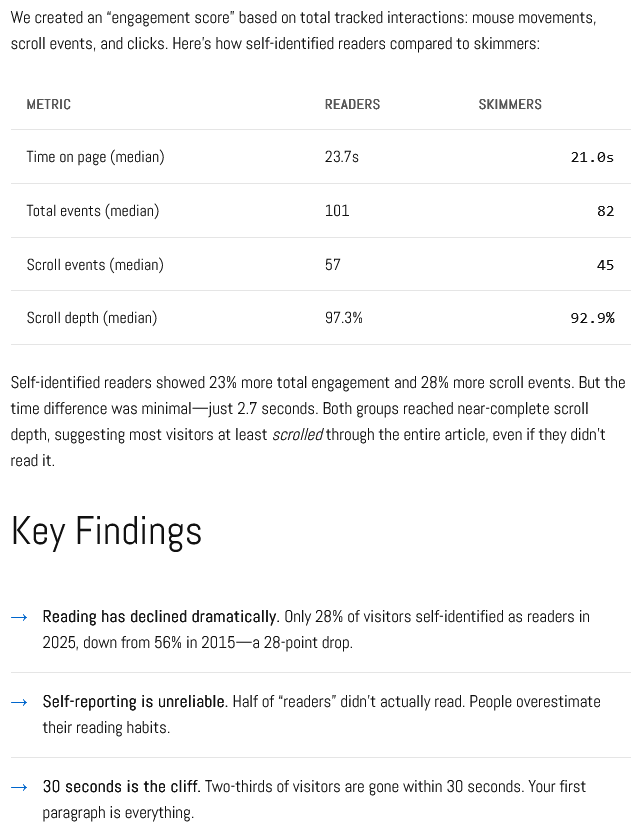
Dan Petrovic’s recent research showed us that while only 56% of B2B-world marketers (a reader-heavy audience if ever there was one) were “web readers” in 2015, half as many (28%) read in 2025. FWIW I like the research methodology as much as anything I’ve seen on the topic — it thoughtfully combines self-reported survey data with real-world analytics on visitor behavior.
But, guess what does read? Crawlers used by search engines and AI tools. They read every word, note every bold typeface, every grammatical nuance, every pattern and link. And the summaries they craft get attention.
AI Overviews and AI mode from Google, responses from the AI tools, AI summaries in ten thousand software products, and AI-powered feeds all subvert the value written content from the historic, direct impact it once had (i.e. people reading stuff) into the text corpus-based models that suck up that writing and turn it into the short sentences we now see and skim.
Prediction: In 2026, Internet users will consume 10X as much content via AI summaries as they will on every page of longer-than-a-paragraph text content (even accounting for the added length of said pieces). Blog posts, substacks, podcast transcripts, long-form articles, paragraphs of detail on e-commerce product pages — all of these combined won’t be 10% of what we consume via AI.
P.S. Once the marketing world internalizes this, many more of us will be writing for machines > humans (a job I personally dread and don’t want to take part in, but one I hope future generations can find joy or at least pride).
#5: Zero-click marketing will comprise the majority of every online journey
TikTok, Reddit, Instagram, Facebook, LinkedIn, YouTube, ChatGPT, even Google — collectively, these platforms both dominate time spent online AND bias against (or entirely restrict) external links. Google does it with AI Overviews and instant answers. ChatGPT does it by summarizing web content it never links to. The social sites do it by making algorithms that reduce the visibility of posts with links (or, like YouTube, Instagram, and TikTok) making links nearly impossible to find.
And, in the last couple years, every one of major social platform converged around TikTok’s algorithmic feed innovation: engaging content > followed accounts. As a result, the value of a follower has never been lower. Following an account or topic on Threads, Reddit, YouTube, Twitter, LinkedIn, Facebook, or Instagram means you’re only a tiny bit more likely to see that account/topic’s content in your default feed. Bluesky and Mastodon are outliers here, but their rates of adoption are so low as to be negligible outside a few niche communities.
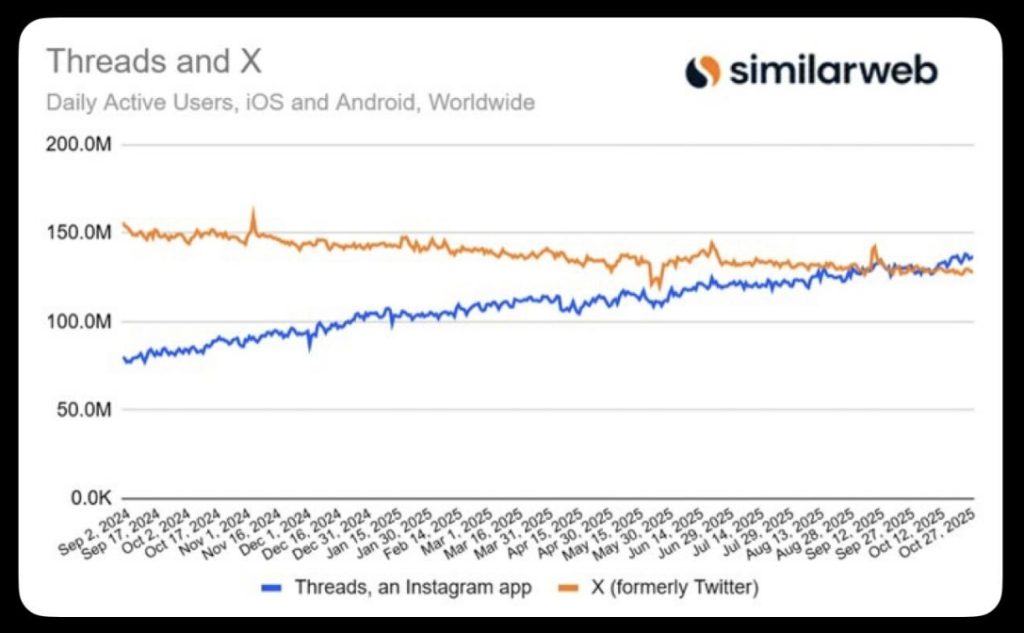
Side note: my prediction that Threads would surpass Twitter in usage in 2026 was wrong… looks like they did it in Q4 2025:
This feed addiction strategy of keeping people engaged with content > followings and zero-clicks > links worked so well that the top 10 platforms dominate >80% of all time spent online in every country, on every device. Social media is now where we get our news, where we learn about products, trends, and brands. It’s how we form opinions. Search and AI usage have both risen dramatically, while sending ever decreasing amounts of traffic out.
We’re living in a Zero-Click World, but marketing is stuck vying for the meager, shrinking scraps of traffic Google and the others still send.
Prediction: By 2027, the amount of traffic sent by all major search, social, and AI platforms will drop from their current low points even as usage of these sites and apps increases.
In Q1 of 2027, I’ll plan to revisit these trends, my predictions around them, and give myself a score (0-5/5) grade. In the meantime, I hope I’m wrong about at least a few of these! 😅