 By
By Several weeks ago, I published some important research about where search happens on the web. Spoiler: everywhere, but ~73% is still Google. This data, fascinating as it is, begets another question – where does influence happen? What do people read, watch, listen-to, browse, and surf on the web *before* they search?
For answers, I turned to our longtime friends at Similarweb, whose mobile and desktop clickstream panel can help answer exactly that. Similarweb’s data methodology builds trustworthy estimates of the entire world’s web browsing experience (I’ve verified their accuracy before, and come away impressed).
My questions this time were:
- Which websites are most popular on the mobile+desktop web?
- What categories of behavior do these sites fall into?
- What’s the distribution of where people spend time online? How many visits go to, for example, search vs. social vs. news vs. commerce?
Thankfully, the Similarweb data, when combined with a bit of manual categorization and some AI classification elegantly got the job done. I hand-sorted the top 200 websites into 15 top-level categories, then used GPT for Sheets to classify the remaining 4,800 sites. I then hand-reviewed the classification of 4 random samples of a few hundred domains at each tier of visitation, and, satisfied that the accuracy exceeded 99%, summed the visits for each category.
That process revealed where influence happens on the mobile and desktop web:
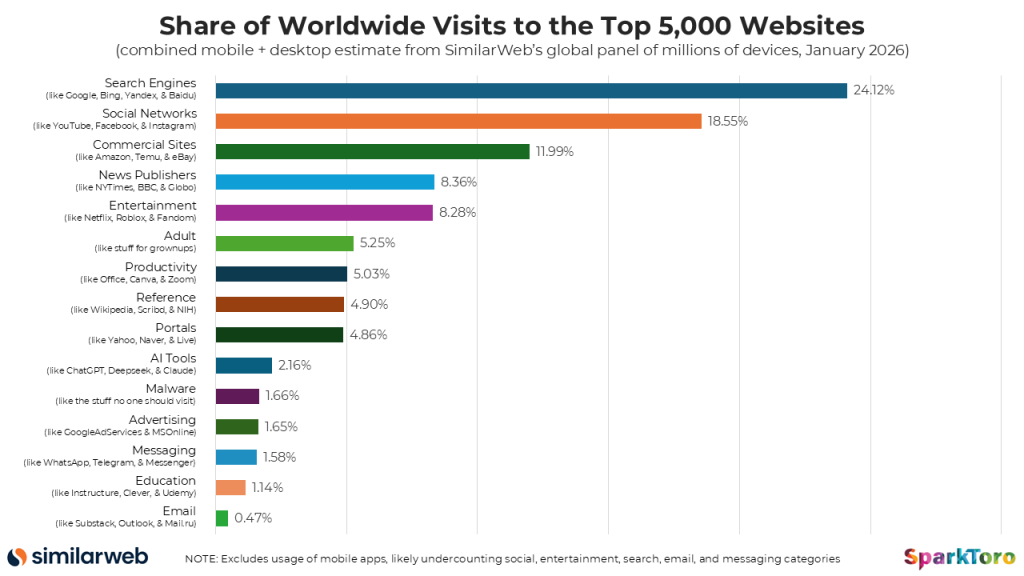
Above, we can see a bar chart of what the world visited in their browsers in January of 2026. Search and social are giant categories, comprising nearly half of all visits to the top 5,000 domains.
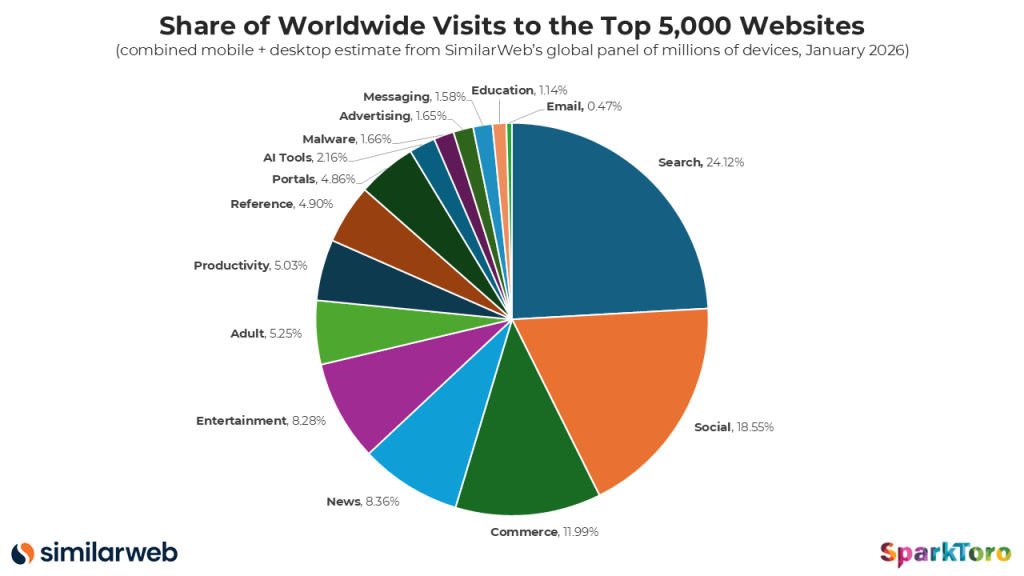
Below is the same data, visualized (for those who still love them) in pie chart format:
Before I get to takeaways, there are some important limitations to this analysis I want to highlight:
- Mobile usage was extremely important to me in this process, which is why we turned to Similarweb. Unfortunately, we’re still excluding mobile apps, a frustrating blind spot in clickstream methodology (thought Similarweb *does* have mobile app data, and we’re talking about ways to compare these apples and oranges in a future report). If these were included, social would almost certainly be the largest category, ahead of search. Email, entertainment, and messaging would be significantly larger as well.
- AI tools will probably get a lot of attention in this report (given the hype), but this analysis probably overstates their share of visits. Because mobile apps are excluded — and AI usage is heavily desktop-skewed (about 94% desktop vs. 6% mobile) — AI appears larger here than it would in a full snapshot of digital behavior.
- Visits to Gmail, the top email provider, redirect to Google.com, further biasing the categorization and undercounting email visits.
- Malware visits, while interesting, are likely not particularly influential from a marketing perspective. I considered removing these entirely from the analysis, but reasoned transparency mattered more than precision given the study’s other limitations.
Another fascinating view of this data came from segmenting the 5,000 sites into similarly-sized buckets of traffic. Here’s what that looks like:
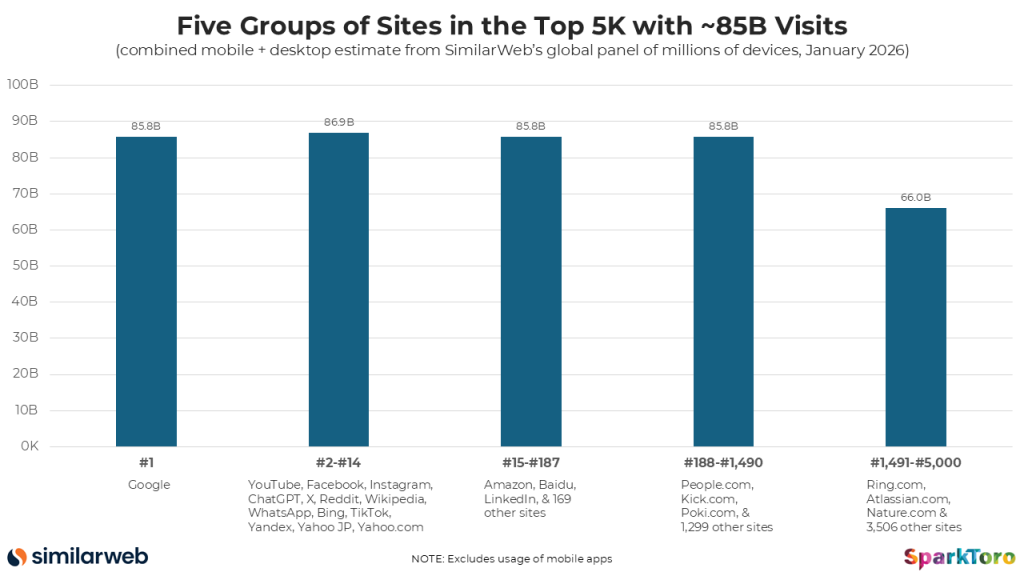
For those wondering just how big Google is, this chart really drives that point home. The search giant isn’t just big on the web, it’s as big as the next 13 largest sites by traffic combined. Anyone who tells you search is dying, Google’s losing, or that they don’t deserve to be classified as a monopoly ought to re-examine their priors. When Earth’s residents use a web browser, mobile or desktop, they visit Google a lot more than they do anything else.
That said, Google (and search more broadly) are less than a quarter of all visitation to the top 5K. Despite Alphabet’s best efforts to keep us from leaving their engine, we still spend time on websites of all kinds. But this explains a fundamental problem with attribution: search gets over-credited because it captures demand in a highly concentrated environment, while the far more fragmented parts of the web get under-credited even though they created demand in the first place.
Marketers’ big challenge with this is what happens after influence is created through use of email, news media, content, social, entertainment, productivity, etc. – we consume content in these places, then go to Google to search. We even do this after AI gives us an answer (proof: ChatGPT is Expanding Search; Google Stays the Default for ChatGPT Users).
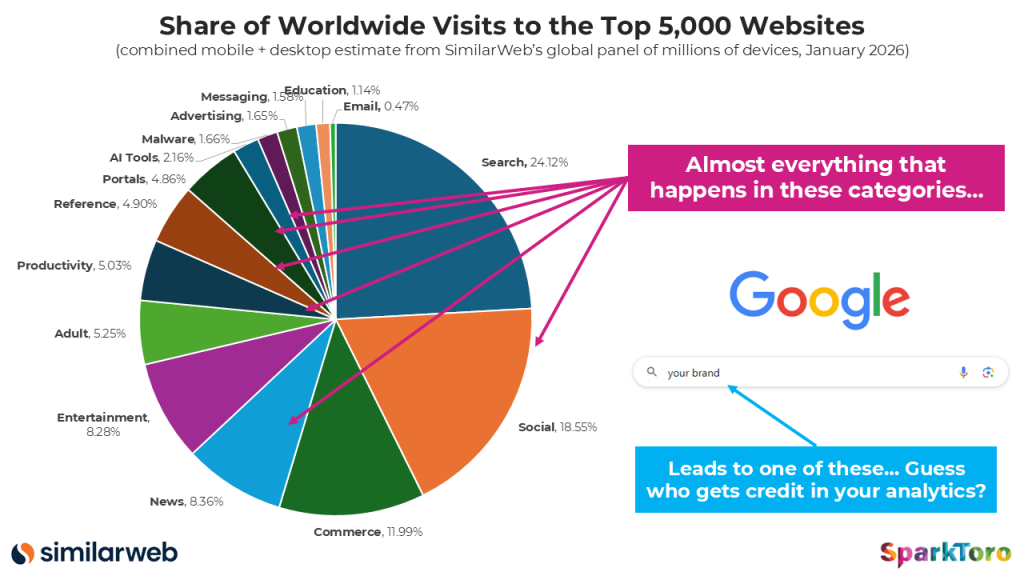
If you’re looking at where your traffic comes from and using that to determine your marketing budget, you’re gonna have a bad time.
Conclusions:
- Influence happens everywhere
- Search, while it’s the largest category, is merely a *response* to influence created in other channels. It rarely creates demand, rather, Search converts interest into answers, navigation, and clicks. Search is the Internet’s middleman.
- Social media and news are (IMO) the most-overlooked channels. Your audience is present in those places, they’re being influenced by what they consume there, and if you’re not present, you’ll lose to competitors who are. Yes, even B2B.
- AI is growing, it’s hot, but the share of visits to AI tools like ChatGPT, Claude, Deepseek, and Gemini is 1/1,000th the size of the breathless press coverage it receives.
- The place AI has the greatest influence on discoverability and marketing is… Google! More than one-third of US search results now show an AI overview. Google is rewriting press headlines with AI. Gmail just started using AI by default (and it’s a pain to turn off). If you’re worried about your AI discoverability, that shouldn’t be because of ChatGPT or Claude, it should be because of Google.
Stay tuned for more research between SparkToro Similarweb; we’re working on an updated analysis of Zero-Click Searches, using their mobile + desktop panel data, in the next few months.