 By
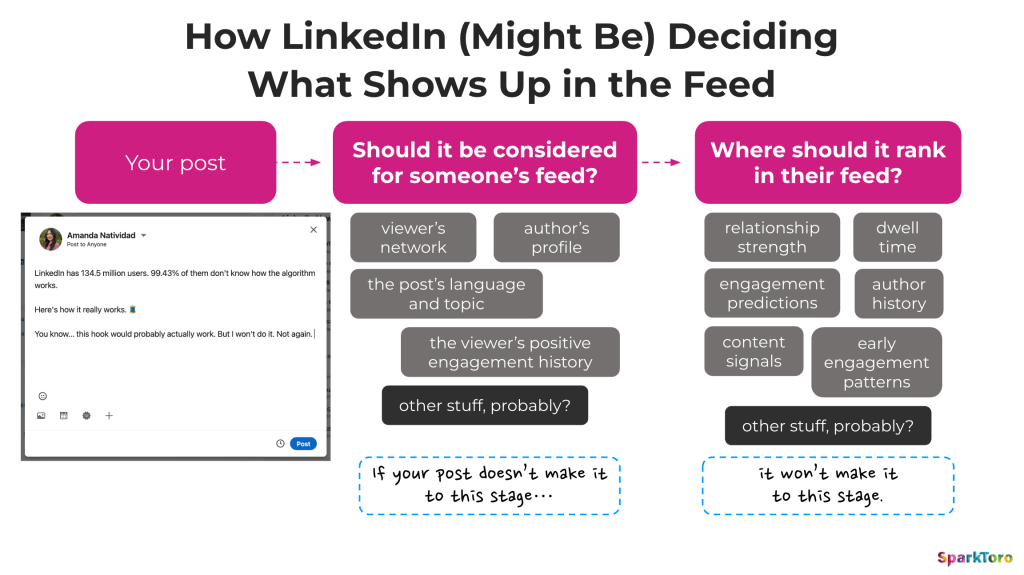
By We marketers talk about the LinkedIn algorithm as though it’s a single behemoth. But a recent analysis from Christopher Penn suggests the platform may be running two separate systems that work together to determine what shows up in the feed.
One system decides whether your post should even be considered for someone’s feed. The other decides where it ranks once it gets there. If that distinction is even partially accurate, it explains a lot about why some posts take off while others disappear into the lonely island of “What Michael B. Jordan’s Oscar win taught me about B2B sales” posts.
It also reinforces a mental model I’ve used for years when thinking about social media distribution and behavior:
Social media (done well) is a lot like being a good party guest.
You don’t walk into a party, hop onto the coffee table, and start shouting over everyone. You walk in, find your friends, and join conversations before starting one of your own.
A similar dynamic may be happening in LinkedIn’s feed.
By the way, if you want the quick, conversational version of this analysis, I covered it in a recent episode of my new show, the Zero Click Marketing podcast. The episode captures my early reaction to Christopher Penn’s guide; this post is the more fully developed version after I had more time to sit with the report. If you’re into quick, thoughtful takes on content, distribution, and how modern marketing actually works, subscribe wherever you get your podcasts. 🙂
LinkedIn’s Two Systems: Retrieval and Ranking
Penn’s “Unofficial LinkedIn Algorithm Guide: Q1 2026 Edition” synthesizes dozens of LinkedIn engineering blog posts, publications, and research papers.
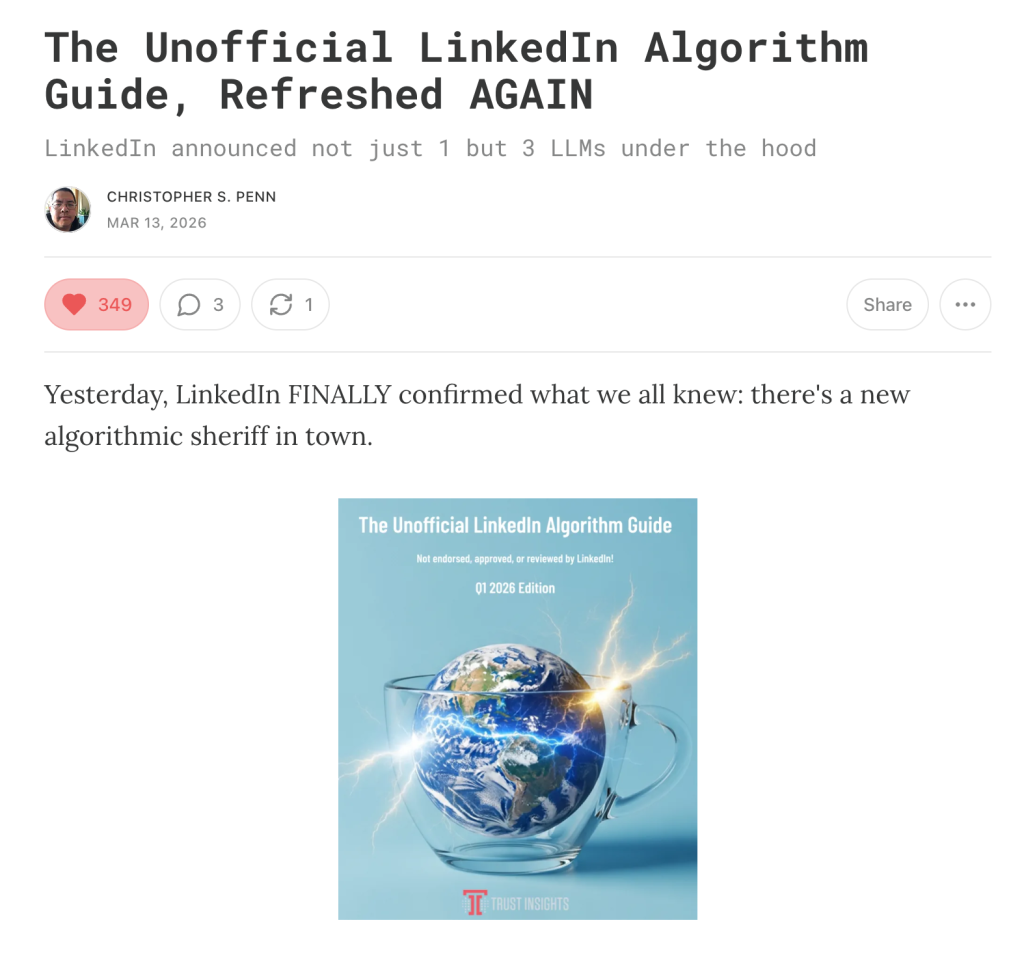
One of the key takeaways is that feed distribution likely happens in two stages:
Stage 1: Retrieval
This is the system deciding: Should this post even be considered for someone’s feed?
This is the stage that narrows the universe of possible content into a smaller candidate pool for a specific viewer. Penn’s guide suggests LinkedIn uses more than one retrieval path here, including one for content from your network and another for out-of-network suggested content. These retrieval systems likely run in parallel, each generating its own candidate set of posts before those sets are merged and sent to the ranking system.
Many different signals are used, likely including:
- the viewer’s network
- the author’s profile and topical identity
- the post’s language and topic
- the viewer’s positive engagement history (notably, LinkedIn’s system only includes positive engagements — likes, comments, shares, reposts, and long dwells — and deliberately excludes posts you scrolled past without acting on. The system learns from what you approve of, not what you ignore.)
The system uses these signals to build numerical representations of both the viewer and the content, then matches them based on semantic similarity — which is why clarity of language in your profile and posts matters so much. The result is a smaller candidate pool of posts that may be relevant to that viewer. If your content never enters that candidate pool, the system won’t evaluate it and it won’t get ranked. “Wait, what exactly is ranking?” you ask, after waiting for me to complete my paragraph. I’m glad you asked, and so politely, too! Onward!
Stage 2: Ranking
Once a post passes the retrieval stage and enters the candidate pool, a second system asks: Out of all the posts that could appear in someone’s feed… which ones should show up first?
Ranking looks more like what we usually think of as “the algorithm.” It doesn’t just look at how much engagement a post has. LinkedIn’s ranker may be trying to predict how likely a specific viewer is to take different actions on a specific post — including passive ones like long dwell and active ones like liking, commenting, or sharing. The system also looks at sequences of interactions over time, which helps it infer stronger relationships between members. It looks at signals like:
- Relationship strength (like mutual engagement history and whether the viewer regularly reads the author’s content)
- Engagement predictions (how likely the viewer is to spend time on it, comment, and react)
- Dwell time (or how long someone is looking at or reading a post before scrolling away)
- Early engagement patterns (or how a post performs shortly after it’s published)
- Content signals (topic relevance, language patterns, whether the content resembles posts that previously drove engagement)
- Author history (interaction history, relationship signals between members, how frequently the author’s posts drive meaningful interaction)
Engaging with an author/individual more frequently may move their post up your feed. Engagement from people who frequently interact with the author, or who are strongly connected to the audience, can carry more weight. A post with moderate engagement can sometimes outrank a viral post — if the system thinks it’s more relevant to you specifically.
All that to say: LinkedIn is trying to find the post that’s most likely to matter to you. This is why retrieval at stage one is so important. If the system doesn’t understand which audiences your content belongs to, your post may never reach the ranking stage for the right people.
Why This Explains A Lot About LinkedIn
For years, LinkedIn (and honestly, most social media) advice has focused heavily on tactical optimization like the best time of day to post, commenting before publishing, and generally warming up by first engaging with what’s in your feed. But all of these tactics assume your content has already been selected for distribution.
If the Unofficial LinkedIn Algorithm Guide is correct, a more important question exists before you even hit Submit: Does LinkedIn understand who you are and what you talk about?
Because that understanding likely determines whether your content even gets considered for distribution.
This model also helps explain some of LinkedIn’s weirdest outcomes. It explains why some posts seem dead on arrival: if they never enter the right candidate pools, ranking never really gets a chance to help. It explains why smaller accounts can sometimes outperform larger ones: in a personalized system, topical coherence can beat scale. And it may help explain why a post can sit among crickets before taking off later: newer engagement signals could help the system better learn which audience should see it next.
Your Profile May Matter More Than You Think
If LinkedIn is using a retrieval stage, the system needs signals to determine which audiences should see which content. Those signals may come from multiple sources, including your profile text, how you talk/type, your engagement behavior, and the people who interact with your content. (Side note: I feel like we’ve seen marketers hypothesize that bot engagement on your profile could hurt your algo. If Penn’s analysis is correct, then it at least adds weight to the broader idea that who engages with you may shape how LinkedIn understands your content and audience… and if that “who” is giving low-quality or irrelevant engagement, well, you can see why marketers worry.)
In other words, your profile may be doing more than just establishing credibility with humans. Profile text doesn’t just help with retrieval; it may also inform ranking by giving LinkedIn additional context about who you are. It may also be helping LinkedIn’s systems understand what topics you’re associated with, what expertise you signal, and which audiences might find your content relevant.
For marketers, this has a simple implication: Clarity matters. The clearer your positioning and messaging, the easier it may be for systems to place your content in the most relevant feeds.
Topic Consistency Matters More Than Random Virality
Another implication of this model is that topic consistency becomes more important than occasional viral hits. If one day you post about marketing, the next day about parenting, the next about crypto, and the next about sourdough bread (er, guilty!), the system — and your audience — may struggle to understand what your content is actually about.
But when your content consistently lives in the same topical neighborhood, it becomes easier for systems to predict who might engage with it. Consistency helps the system understand which conversations you belong in.
Why Seemingly “Random” Posts Take Off
Some common LinkedIn mysteries are when smaller accounts outperform larger ones, or posts that seem to hit the feed with a clunk before suddenly gaining traction. But in a personalized recommendation system, relevance can beat scale — so a smaller account with a highly coherent topic and audience may be easier for the system to match with the right viewers.
Or when a post sits in the feed and takes longer to receive engagement or feedback, the system may need more time to figure out which audience might care about the post, thus expanding reach later on.
What This Means for Marketers
If LinkedIn’s feed really works this way, the goal isn’t gaming the algorithm. It’s becoming easy for the algorithm to understand.
For marketers, that may mean focusing on things like:
- Clear positioning: Make it obvious what you talk about and what expertise you bring.
- Topic coherence: Stay relatively consistent in the conversations you participate in.
- Participation before promotion: Join existing conversations before trying to start one of your own.
- Audience alignment: Engage with the communities you want your content to reach. And be intentional about what you engage with; not just how much. Because LinkedIn’s retrieval system builds its understanding of you from your positive engagement history only, scattered, off-topic engagement can dilute the signal that determines which audiences see your content.
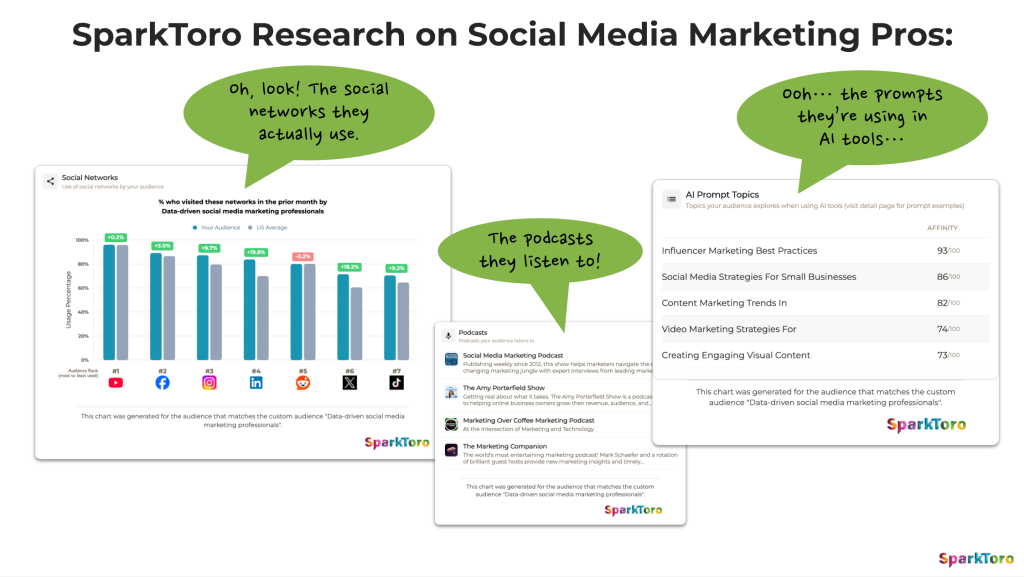
This is also where SparkToro can be a particularly useful partner. If LinkedIn’s retrieval system is trying to understand who you are, what you talk about, and which audiences your content belongs with, then audience alignment can’t just be you holding a finger to the wind. You need to know which creators, publications, podcasts, websites, and topics your audience already pays attention to. That’s the kind of research SparkToro is built for. It helps you identify the communities and signals that already matter to the people you want to reach — so you can engage more intentionally, participate in the right conversations, and create content that’s more likely to resonate with them.
What I’m Doing Differently Now
In case you were wondering, I have been one of those people who frets over the best time of day to post. I know that generally, traffic to LinkedIn is lower on the weekends, and natural upticks in traffic tend to be when people are taking a break at work. I’ve (almost) always timed my posts to publish first thing in the morning. I open the app, see what’s going on with my friends, acquaintances, and peers, run out to drop my kids off at school while my scheduled post hits feeds, then return to scroll and engage while I’m sitting at my desk with coffee. It usually works well for my schedule, but even now I’m starting to rethink it. Maybe I should just post when I truly am in the mood and immediately available to reply to people. This might be at 9am, 2pm, 9pm, or… just kind of whenever.
I’m also going to be more mindful about the questions I ask the community. Typically, I don’t end my posts with a question; it’s not that I’m not interested. I just figure, “Eh, if people want to weigh in with their two cents or ask questions, happy to have them! Whatever comes up naturally!” But Penn’s analysis has me thinking even more about the types of conversations I hope to see come to fruition on my profile. So maybe you’ll see me ask more questions now.
Penn’s analysis also suggests that LinkedIn’s ranking system doesn’t treat all engagement equally. It may distinguish between passive signals like dwell time and higher-intent signals like comments and shares. In other words, the system may architecturally distinguish between “this person paused to read it,” and “this person found it valuable enough to respond to.” Which makes me think that fostering genuine conversation isn’t just good community-building — it may be one of the stronger signals you can send to the ranking system.
But if there’s one thing I’m really going to stick with, it’s maintaining a high signal to noise ratio. There was a time that I was posting 5 times per week. But as my schedule filled up and burnout crept in, I found I was going days, sometimes even a week or two without posting at all. I’m aiming to keep some kind of regular cadence, though I may aim for 3, maybe 4 posts per week because that may be what’s most sustainable for me without sacrificing quality. Penn’s analysis also describes a hard 30-day limit in LinkedIn’s connection-based retrieval system. After 30 days, your post can’t be surfaced through that path, regardless of how well it performed. So going a couple of weeks without posting isn’t just a missed opportunity for visibility — it means fewer of your posts are even eligible to be retrieved at any given time.
As my LinkedIn behavior evolves, though, maybe I’ll be able to foster more thoughtful discussions, stumble upon fresh perspectives, and… even if the “LinkedIn machine” doesn’t like it, I’d love to keep occasionally veering outside of marketing to talk about things like sourdough, fashion, and parenting. After all, the best parties aren’t full of the same type of person talking about the same exact thing. They’re full of people with different interests, hobbies, and opinions — bonded by shared values.