 By
By A couple stats kind of make me laugh in our Google Analytics: our direct traffic, which states that around 45% of our traffic is direct; and our search traffic, which states around 24% of our traffic is from search. Google Search Console isn’t much more helpful. All I really know from there is that the way a lot of people find SparkToro is by searching for “spark toro” and “rand fishkin.”
The only thing GA4 tells me is where someone showed up right before analytics noticed them. It’s directionally useful, but mostly, it reminds me that the channel that captures demand is not always the channel that created it.
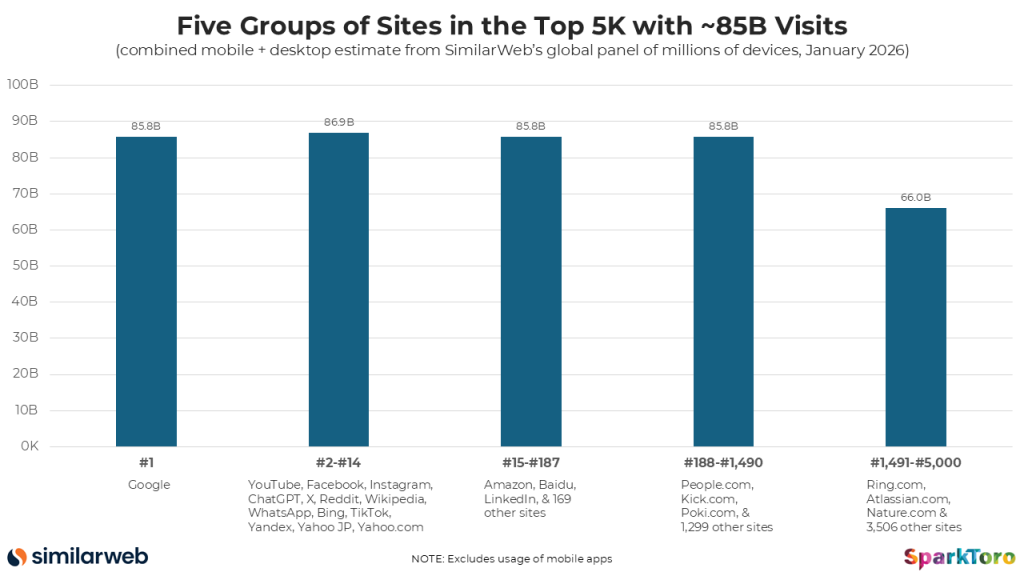
Rand’s recent research on the top 5,000 most-visited websites makes this painfully clear. Search and social together make up nearly half of visits to those sites, which is huge. But search (a.k.a. Google) is nearly a quarter of that visitation overall. People are spending time across social media, news, commerce, entertainment, email, productivity tools, and a long tail of other destinations before they ever decide to search for something. In other words: search is concentrated, while influence is fragmented.
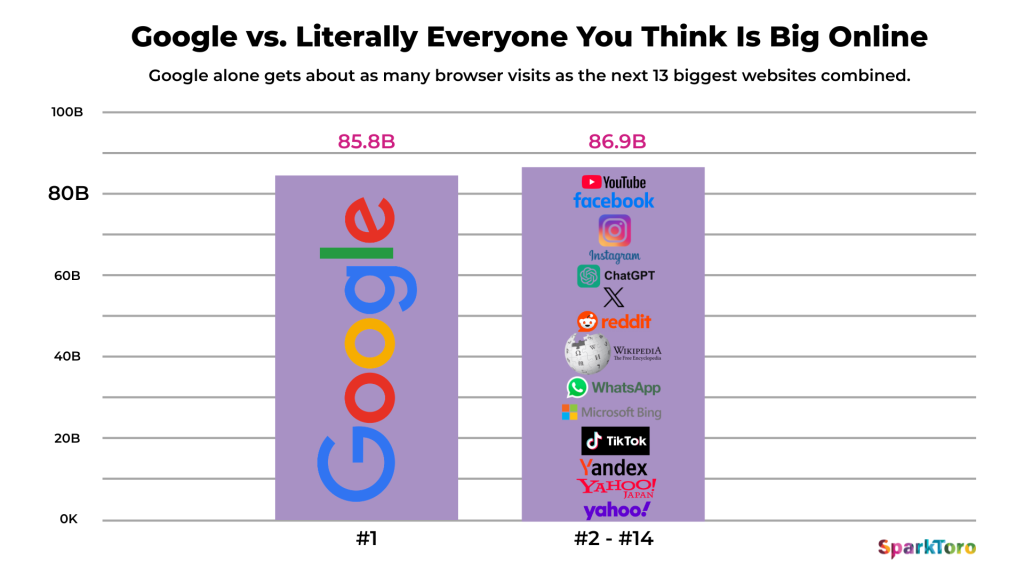
Google is so big that in Rand’s analysis, it is as large as the next 13 sites COMBINED. (See that absurd chart above?) People spend time all over the web, where awareness is built, trust is formed, and demand starts to get, er… generated. But when someone eventually Googles your brand, your category, or the problem you solve, search gets way too much credit. What actually happens — and it’s so freakin’ frustrating that we almost never see it — is that someone sees a post on LinkedIn, they hear a company’s founder on a podcast, they see a sponsored post in a newsletter they trust, a peer drops the company’s name in Slack, and then after that, the user searches the company on Google and makes the conversion. We can’t see this pinball journey and we have no idea how the customer is actually progressing through that funnel, vortex, ladder, or whatever the heck it’s called now.
But we’re finally seeing more breadcrumbs of what’s happening. We’re moving away from an era of “rank my page” to an era of “influence the public record.” That public evidence includes your website, yes. But it also includes reviews, forums, discussions, search snippets, branded facts, third-party mentions, and the pages AI systems find easiest to cite and summarize. If those surfaces influence whether people trust, remember, or search for you later, then they’re part of performance whether Google Analytics can cleanly assign them a row in a channel report or not.
Rand’s other report on where search actually happens sharpens this even more. Across 41 major desktop sites in the US in Q4 2025, Google accounted for 73.7% of searches. Traditional search engines as a group made up about 80% of all searches; commerce sites accounted for about 10%; social platforms 5.5%; and AI tools 3.2%. Amazon, Bing, and YouTube each had more search activity than ChatGPT in that dataset. Put another way: search is a behavior, not a channel, and a lot more of it happens across the web than the usual Google-versus-ChatGPT discourse suggests. And since search is a behavior that happens everywhere, it means you/your brand has to show up credibly everywhere. (Ok fine, not literally everywhere. But definitely in more places than just your own website.)
And by the way, if you want an audio version of this blog post, I recently published a new episode of the Zero Click Marketing podcast: ZCM Field Notes: Search Is Now an Evidence Game (Ugh, Thanks, AI). This blog post is a more polished version of that episode, but the podcast has the same ideas.
Now… daunting as this is, it at least gives us a better way to think about our jobs. Our friend Cyrus Shepard’s recent research explains that our job is not just to rank, and it’s not even just to win the click. It’s to look like the result most likely to satisfy the searcher — and then actually do it. In his analysis of Google’s click signals on Zyppy Signal, Cyrus argues that Google appears to evaluate whether a result earns the click, whether the content proves useful, and whether it satisfies the search strongly enough that the user doesn’t bounce back to keep looking. Which means your search presence is not just your page rank. It’s the whole body of public evidence that makes your result look relevant, credible, and worth choosing in the first place. Cyrus’s new Zyppy Signal newsletter is absolutely worth the weekly read, and you can subscribe here:
Ross Simmonds at Foundation Inc makes this even more concrete. In his new research on Reddit’s role in B2B SaaS search, he found that third-party discussion is not just siphoning off a few “best software” keywords around the edges. In his analysis of 8,566 keywords across 14 SaaS domains, Reddit outranked every vendor simultaneously on 50-66% of shared keywords in 3 of 4 verticals. Even more interesting: 77% of the search volume Reddit won came from generic category keywords, not just “best,” “review,” or “alternative” terms. And as queries got longer, Reddit’s advantage grew, with win rates hitting 73-100% across verticals for six-word-plus searches. In other words: the public record is not just your website plus some reviews. It’s also the discussions happening in places like Reddit, where buyers increasingly run into other people’s opinions before they ever land on a vendor site.
Wil Reynolds’ recent experiment at his agency Seer Interactive shows the flip side of this. One negative review theme — “high account manager turnover” — kept surfacing in branded AI outputs, appearing 67 times in their tracking. Wil traced that back to a small set of review domains, where thin, repeated evidence was effectively being treated as corroboration. Once Seer published real retention data and made it public, Perplexity cited the post immediately, and after just two citations, LLMs stopped referencing “high turnover” altogether. But the fix did not fully stick on its own: over time, citations faded, Seer republished an updated version, and then the retention stat started showing up again. It’s a pretty good reminder that if your strongest proof points are trapped in Slack, finance, HR, customer calls, or your founder’s head, they’re not part of the public record yet. And if they’re not published, they’re not really helping you.
Search still matters tremendously. Rankings and clicks still matter. But they all matter differently, because the public, crawlable evidence surrounding your brand matters more than ever. And yep, our job as marketers has gotten even harder: publish the proof, guide the conversation, and make sure the web has enough accurate, credible signals to trust, repeat, and recommend you. Because if you don’t influence the public record, someone else will.