The Death of the Ultimate Guide?
For years, marketers were taught to win by publishing the most comprehensive answer. Build the “ultimate guide.” Cover every adjacent subtopic. Anticipate every follow-up question. Be the page that has everything. That advice made a lot of sense in an era when the job was largely to rank, earn the click, and keep the visitor on your site. Heck, we have one of those guides and at the time of this writing, it’s still doing pretty darn well for us.
(By the way, if audio is your jam, you can listen to my latest episode of the Zero Click Marketing podcast; it’s not a read-through of this blog post, but I cover similar points.)
But two recent pieces of research suggest that the ultimate guide era could be ending too. One looks at which websites are winning in Google. The other looks at which pages get cited by ChatGPT. Different systems, different methods, different levels of analysis — but they point in a similar direction. Broad, commodity-style content is looking increasingly vulnerable, while focused usefulness and hard-to-replace value are looking increasingly important.
Google’s winners are harder to disintermediate
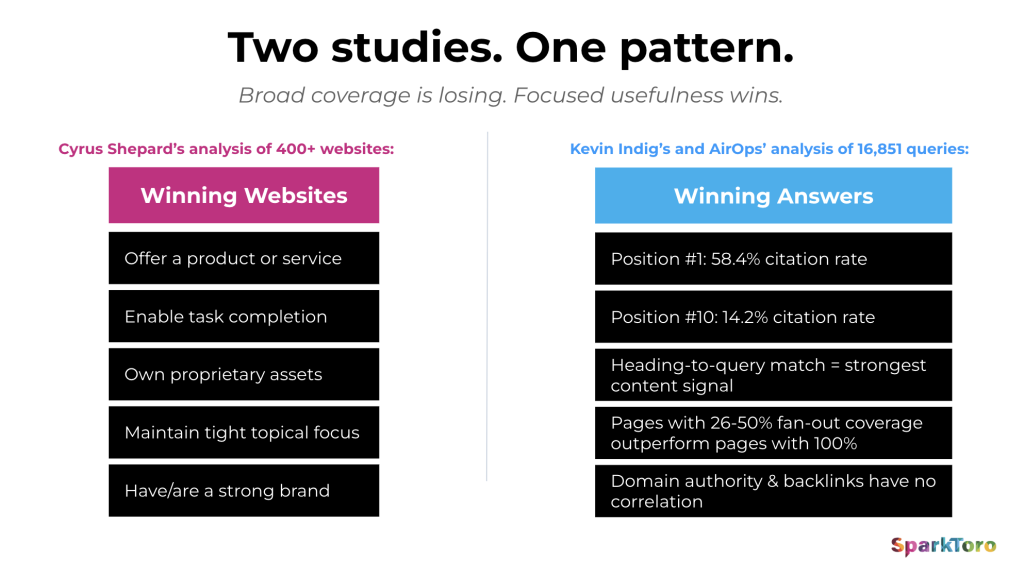
In a recent post, Cyrus Shepard analyzed more than 400 winning and losing websites and looked for features associated with year-over-year Google traffic gains and losses. He found five characteristics that strongly predicted whether a site was winning or losing: offering a product or service, allowing task completion, having proprietary assets, maintaining tight topical focus, and having a strong brand. He also argues that Google has moved beyond simply ranking “good content” to rewarding what AI can’t replicate.
It’s not that content quality no longer matters. Content quality alone is no longer enough to explain who wins. In Cyrus’s dataset, the highest-correlated differentiator was offering a product or service, followed closely by allowing task completion and owning proprietary assets. Tight topical focus and brand also mattered. In other words, the winners were not just well-optimized pages. They were often sites with clearer utility, clearer ownership, and clearer reasons to be sought out directly.
A site with just one of these traits was not very likely to be a winner. But as more of the traits stacked up, win rates rose sharply. In the dataset, sites with zero features had a 13.5% win rate, while sites with four features had a 68.1% win rate and sites with all five had a 69.7% win rate.
Like Rand said last week in his analysis of Cyrus’s work: Google’s winners are harder to disintermediate. They are more likely to help someone actually do something, own something unique, stay tightly focused, and build enough brand demand that users seek them out on purpose. That does not mean every site needs to become a software company tomorrow. But it does suggest that broad informational content, by itself, is no longer a particularly defensible moat.
What winners and losers look like
So what do the winning and losing websites look like? Cyrus names Byrdie as a losing example. And honestly, that makes sense. Byrdie has lots of polished content. It covers fashion and beauty products. But in Cyrus’s framework, it doesn’t really offer its own product, and it doesn’t let the user complete the task. You can read about the thing, but you usually can’t do the thing there. Contrast that with a site like Dermstore. It covers skincare and beauty products, and it even sells them directly too. You can read about the thing and you can do the thing in one place.
TechTarget is a different kind of loser. It’s niche. It’s known. But Cyrus points out that most of its traffic comes from long-tail keywords, not people actively looking for TechTarget itself. So it has recognition, but not enough destination demand.
Then there’s Mental Floss, which shows up as a winner — and this is the brand lesson. People search for “mental floss.” They’re not just searching generic trivia questions and stumbling into it. They’re seeking out the site by name. While you don’t need to have decades on your side to be a well-known brand, in this case, it’s hard not to see Mental Floss’s advantage in being among the first to post quirky informational trivia-like content.
That’s the difference between content people find and a brand people remember.
In all these examples, you can see that this is bigger than SEO. It’s not just asking, “Did we publish a good article?” It’s asking, “Are we building something people actually come back for?”
ChatGPT citations favor relevance over breadth
The AI study, from Kevin Indig and AirOps, looks at the question from a different angle: what happens between a user’s query and a citation in ChatGPT? Their study analyzed 16,851 queries and 353,799 pages across ChatGPT’s retrieval pipeline. They captured the original query, the internal fan-out queries ChatGPT generated, the URLs returned, and the pages that were ultimately cited. Most queries generated exactly two fan-out sub-queries.
The first big finding is that retrieval position matters enormously. In their data, the first returned result had a 58.4% citation rate, while the result in position 10 had a substantially lower citation rate of 14.2%. So while being cited is partly about content, it’s also about being retrieved prominently in the first place.
This ChatGPT research feels especially relevant for marketers who have spent years worshipping comprehensiveness. The study found that query match — specifically, heading similarity to the original user query — was the strongest content signal they measured. Fan-out coverage mattered much less than you might expect. When they controlled for strong primary similarity, pages covering 26–50% of fan-out subtopics outperformed pages covering 100%. Their conclusion is blunt: “A page that nails one question outperforms a page that adequately addresses five.” (RIP all of our ultimate guides, I guess?)
A bigger pattern is emerging
Cyrus Shepard and Kevin Indig are looking at two different systems. Cyrus is analyzing which sites are winning in Google. Kevin and AirOps are analyzing which pages get cited in ChatGPT. They’re not the same, but put side by side, they point to a similar pattern where broad commodity content is becoming more vulnerable, while focused usefulness and hard-to-replace value are becoming more important.
Cyrus’s winners are more likely to be sites with distinct utility and distinct reasons to exist. Kevin and AirOps, meanwhile, found that ChatGPT citations are shaped heavily by retrieval position and by how directly a page matches the original query. Broad fan-out coverage matters much less than many marketers would assume, and once primary relevance is held constant, exhaustive coverage can actually underperform more moderate coverage.
Another way to say it: Cyrus is telling us what the winning website looks like, and it’s a destination that needs to be worth seeking out. Kevin is telling us what the winning answer looks like, and it’s an asset that needs to be worth citing.
What marketers should do now
Now… if you’re a content marketer (and most likely, if you’re reading this, you are?), it might be tempting to reduce all this to a formatting lesson. Write tighter headings. Narrow your scope. Break big guides into smaller pages. Some of that is probably directionally right. But if that’s where you stop, you risk missing the bigger point: this SEO/AI snafu is not just a content issue. It’s a business issue.
Cyrus’s research is pointing to forms of business defensibility: products, services, tools, proprietary assets, task completion, and brand. Those are strategic choices about what your company makes, what it owns, and why anyone would need to come to you instead of accepting a summary from Google or an answer from ChatGPT.
AirOps points to a parallel kind of content defensibility. Their findings suggest that a page is more likely to be cited when it is clearly about one thing and closely matches the original query. And it might surprise you that they also found that domain authority and backlinks did not positively correlate with citation in this dataset, which makes the signal even clearer: at least in this retrieval pipeline, relevance and structure mattered more than traditional authority indicators.
If your website is easy to summarize, easy to substitute, and easy to outrank with a more focused page, your problem is not only editorial. It may be that your content is generic. It may be that your brand is forgettable. It may be that your site gives people too few reasons to come to you directly. If this pattern holds, then maybe we’ll see that the future belongs less to commodity content and more to distinct value: focused usefulness, sites worth visiting, and pages worth citing.