Audience Research Brief: How We’d Market to Mid-Market RevOps Leaders
But seriously, how does audience research inform your marketing strategy?
I often say audience research is the heart of it all. And in a sense, I don’t think most marketers would disagree. We use different words for it — customer insight, positioning, voice of customer, ICP development — but a lot of it comes down to the same questions:
- What does this audience care about?
- Where do they spend time online?
- How do they talk about their problems?
- Who do they listen to?
- What are they searching for?
- And what would actually help them make a decision?
The way to answer those questions is, say it with me: audience research.
That’s why we’re starting this new content series, the Audience Research Brief. Each week, we’ll run audience research on a specific group and show what’s unique about that audience — and, more importantly, how we’d think about marketing to them.
This week’s example: mid-market RevOps leaders at B2B SaaS companies.
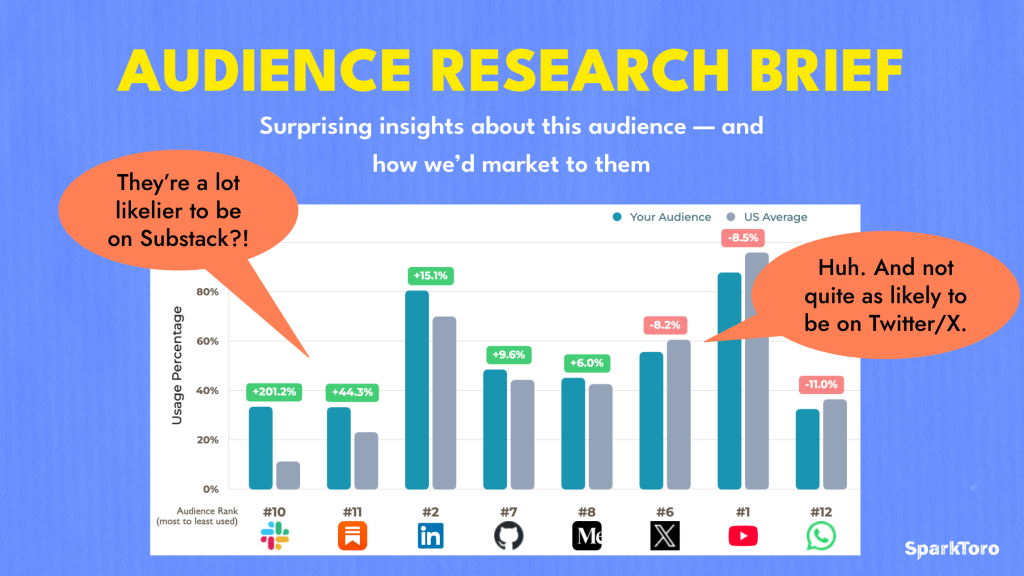
A typical campaign for this audience might start with LinkedIn account-based marketing (ABM), a Pavilion sponsorship, and a few blog posts around revenue operations. Reasonable enough. But how would this actually get done?
So we ran a SparkToro report for this audience and asked:
Where does this audience actually spend time, pay attention, search, listen, and learn — and where might marketers be missing them?
The short answer: LinkedIn matters. But it’s not the whole story. The more useful opportunities are hiding in the places where most B2B vendors do not yet have a clean playbook.
Let’s walk through the three key insights…
Insight #1: LinkedIn is obvious. The better question is where they learn.
Of course, this audience uses LinkedIn. According to our SparkToro report, 80.3% of this audience uses LinkedIn monthly, and they over-index by 15% compared with the US average:
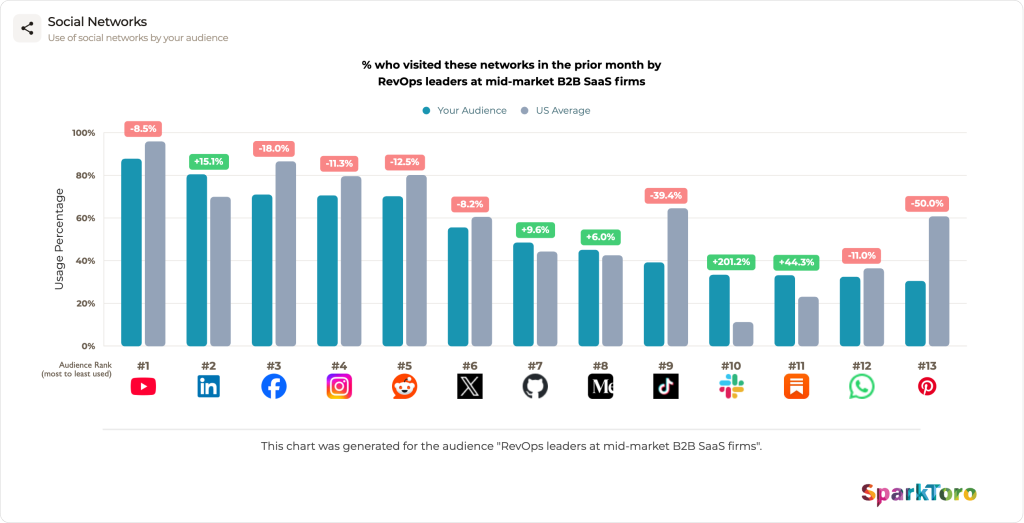
The more interesting part of the report isn’t just which platforms show up. It’s what those platforms tell us about the audience’s work habits, information diet, and decision-making environment.
For example, Slack jumps out immediately: 33.2% of this audience uses Slack monthly, and they over-index by 201% compared with the US average. But it isn’t reasonable to give advice like, “Now go build a Slack marketing strategy.” My stronger sense is that most RevOps leaders are probably using Slack because it’s their company chat tool. But even that give us a data point. It likely signals they work in fast-moving, cross-functional environments where internal conversations shape decisions. Unfortunately, you can’t request an invite to their company Slack and start doing demand gen there. But what you can do, at least fathomably, is think about creating things worth bringing into those internal conversations.
A useful RevOps asset is not just something that gets clicked. It’s something a VP of Revenue can drop into Slack with a note like, “This is exactly what I’ve been trying to explain,” or “Can we talk about this in our team meeting on Monday?”
And that asset could be a:
- benchmark report
- teardown of a common RevOps mistake
- calculator or diagnostic
- spicy-but-useful point of view
- workflow template
- comparison guide that makes an internal debate easier
Slack may not be the channel you market in. But it very well could be the place your best content gets forwarded through.
Meanwhile, on that list of social networks, Substack is more actionable. This audience uses Substack at 33.0% monthly and over-indexes by 44%, which suggests newsletter sponsorships, guest essays, creator partnerships, and earned mentions may be worth testing.
So yes, LinkedIn belongs in the plan. But if your whole strategy is LinkedIn-first because that’s where B2B buyers are, you may be missing the more useful question:
Where does this audience find ideas they trust enough to repeat internally?
Insight #2 This audience is on Claude. A lot.
The Search & AI Tools data gets even more interesting:
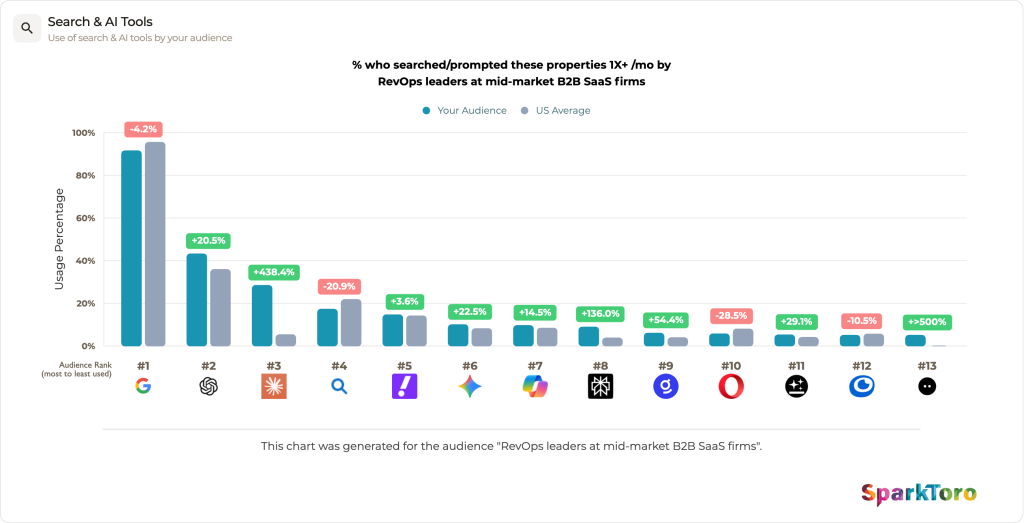
Roughly one in three people in this audience uses Claude, and they over-index by 438.4% compared to the US average. This audience also over-indexes on ChatGPT, Gemini, Copilot, and Perplexity. Most likely, this buyer is already asking AI tools questions before they ever get to your website.
So aside from asking, “Where is this specific audience using search, AI, communities, newsletters, podcasts, and websites to form an opinion before they talk to us?” We ought to consider asking, “What are some of their prompt topics in AI?” Lucky for you, we have an app (er, feature) for that? 🙂
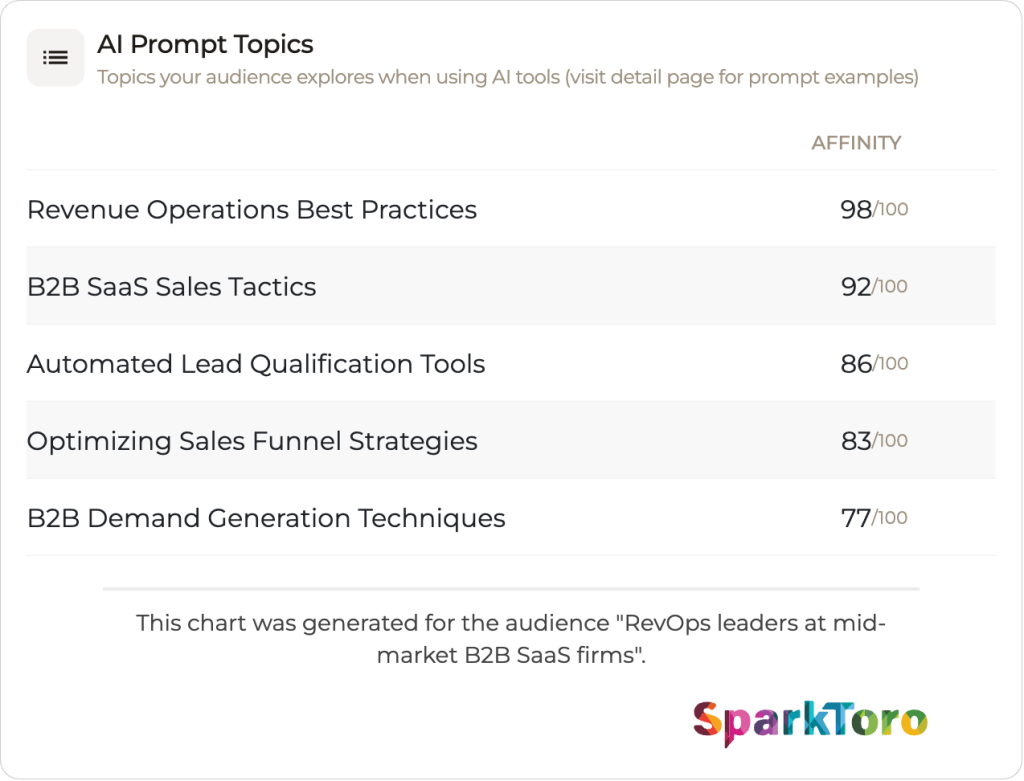
This RevOps audience is prompting AI for best practices, sales tactics, automated lead qualification tools, and optimizing sales funnel strategies. They’re looking for strategies, playbooks, and tactics. That in of itself might not be that surprising, but now you know what types of strategies they’re looking for.
- For the product marketing, these findings can change website copy.
- For content marketing these can change the editorial calendar.
- For demand gen, these can change what gets promoted.
- For brand marketing, these can change where you need to be cited, mentioned, explained, and remembered.
Insight #3: The obvious websites are useful. The Hidden Gems are where I’d look harder.
The top-affinity websites are about what you’d expect. SaaStr, Sales Hacker, Clari, Gong, Salesloft — these are all places you’d expect a RevOps-adjacent SaaS audience to show up. But the Hidden Gems show some of the most interesting areas of opportunity:
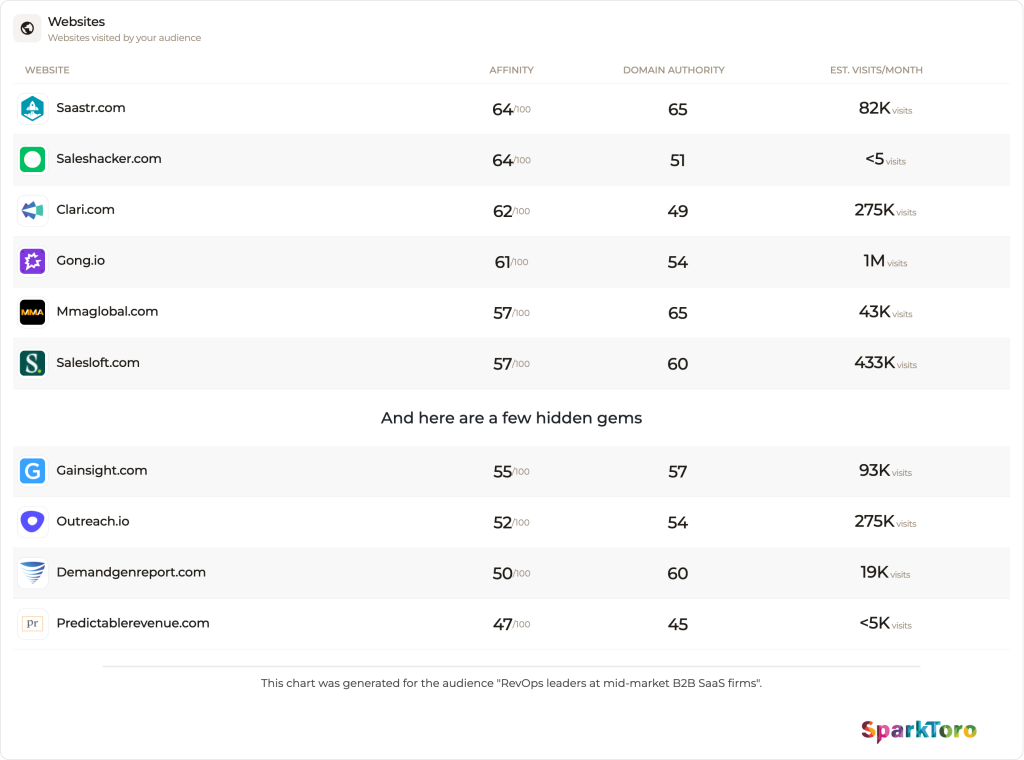
That Predictable Revenue result is exactly the kind of thing I’d want a partnership or content team to notice. Low mainstream traffic. High relevance to this specific audience. Not the biggest platform. Possibly a much better fit.
The same goes for podcasts.
The report shows strong affinity for shows like Strategy Sprints, CEO Sales Strategies, The B2B Revenue Executive Experience, Revenue Leaders, and The RevOps Review.
If you’re a partnership or co-marketing lead at a vendor targeting this buyer, those names are sponsored-newsletter, guest-post, and webinar-partner targets where your competitors might not yet be competing.
A quick methodology note we owe you, in the spirit of transparency: the “Employer Industries” breakdown for this audience shows 11% in hospital and healthcare alongside the expected ~18% in software/IT — a reminder that the audience description “RevOps leaders at mid-market B2B SaaS” is interpreted broadly by SparkToro, capturing RevOps practitioners who also index against B2B SaaS interests, not strictly people whose employer is a B2B SaaS company. If you wanted to tighten the cohort to strictly software-vertical RevOps, you’d refine the description further. We left it broad here because it more accurately reflects the universe a B2B SaaS vendor is trying to reach.
What We’d Actually Do With This
Those are the standout bits of info to us. Now here’s the 30-minute exercise you could do right now.
Pull an audience research report. Take the top sources from Websites, Podcasts, Social Networks, Search & AI Tools, Keywords, and Topics. Then compare them against your current plan.
- Where are you already spending?
- Where are you creating content?
- Where are you trying to earn mentions?
- Where are you buying placements?
- Where are you completely absent?
How does this change your next decision? For example:
- A demand gen marketer might realize the plan is too LinkedIn-heavy and decide to run a small pilot around newsletter sponsorships, podcast placements, or community-based partnerships.
- A content marketer might build content around “AI in sales,” “revenue operations best practices,” “b2b sales metrics,” or “automated lead qualification tools” — because this audience is already signaling interest in them. Added bonus if those get meaningful search volume.
- A partnership marketer might look at hidden-gem sites and podcasts before chasing the biggest, most obvious industry names.
- A brand marketer might stop treating AI visibility as an SEO side quest and start asking: when this audience asks Claude or ChatGPT about our category, do we show up as a credible answer?
- A product marketer might use the keyword and topic language to rewrite landing page copy so it sounds less like internal positioning and more like the way buyers actually describe their problems.
And a CEO or CMO might ask a harder question:
Are we spending against the channels we’re used to, or the places our audience actually learns, searches, and makes decisions?
That’s the needle-moving question. Audience research is not just for content ideas. It’s not just for PR. And it’s not just for finding podcasts. It’s the foundation every marketing function plans against.
A single SparkToro report can change a paid media plan, a podcast strategy, a partner list, a product marketing brief, a webinar calendar, and a board-slide explanation for why you’re reallocating budget.
That’s what we’ll be showing in this audience research series: the same basic workflow applied through different marketing functions. See ya here next week.