How We’d Market to Software Developers at Startups
How do you market to developers? Developers have a reputation: they block your ads, they smell marketing-speak from three sentences away, they trust a random GitHub repo over your whole campaign, and if they’re reading this, they are rolling their eyes (hi Casey!). So most teams either throw money at LinkedIn ABM, or they decide developers are “unmarketable” and go around them to a VP.
Both moves skip the obvious first step. So instead of guessing, we ran a SparkToro report on software developers at startups in the U.S. Three findings genuinely surprised me — and at least one of them flips the standard playbook on its head.
Insight #1: This audience uses Google less than the average American — and has already gone AI-native
No surprise, this audience real is AI redpilled.
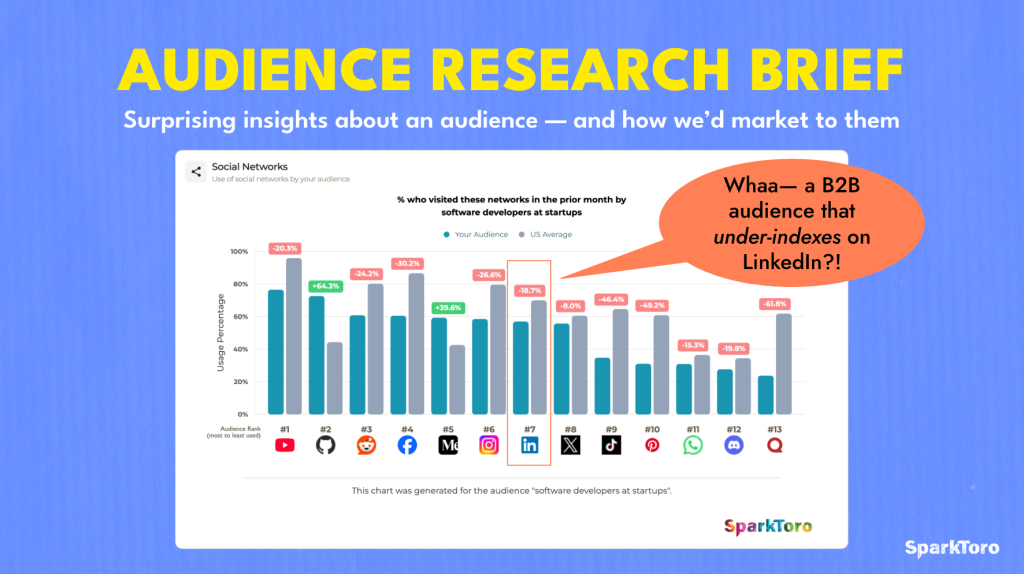
But what did surprise me is that only 81.9% of this audience uses Google, compared with 95.5% of the U.S. population — a 14% under-index. Sit with that for a second. Software developers are basically online for a living and yet, they use Google less than your average person does.
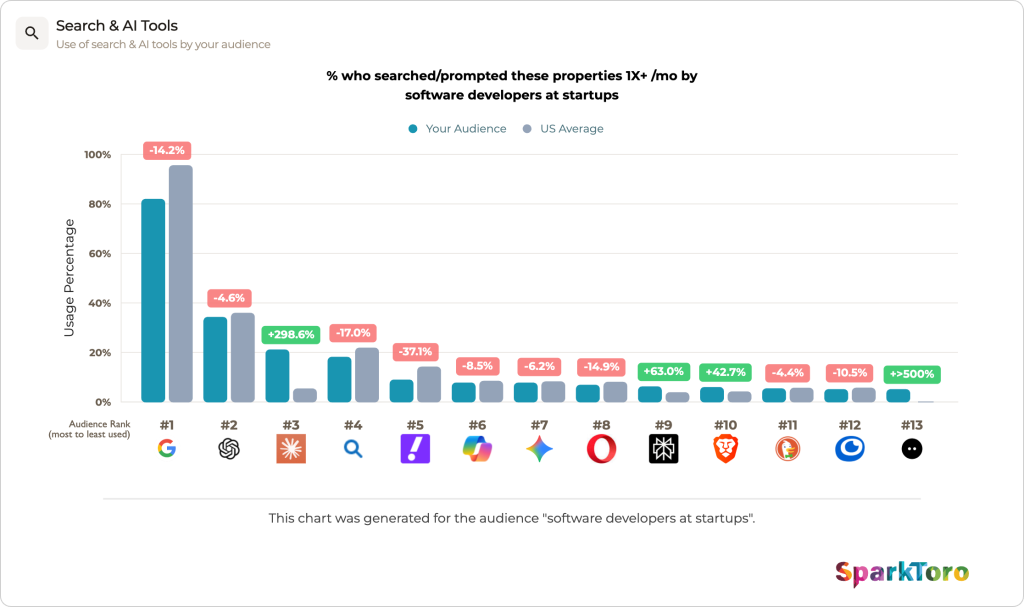
So where did that attention go? Some of it to ChatGPT — but not in the way you’d expect. ChatGPT lands right around the national average for this group (34.2% use it, a 5% under-index). Everyone uses ChatGPT now. It’s table stakes, not a differentiator.
The differentiator is Claude. About 21% of this audience uses Claude, and they over-index by nearly 299% — roughly four times the national rate. (If that rings a bell, it should: our mid-market RevOps audience over-indexed hard on Claude too. There’s a pattern forming with technical buyers.)
And the AI-native story keeps going as you move down the list into power-user territory: Perplexity over-indexes by 63%, Brave by 43%, DeepSeek by 22%, plus a long tail of developer-favored tools — Kagi, Phind, even searchcode — that barely register with the general public.
What does that mean for marketing? The classic SEO question — “how do we rank #1 on Google for developers?” — matters less than you’ve been told. More accurate would be to ask:
When a developer asks Claude or Perplexity about your category, do you show up — and do you show up accurately?
For this audience, AI visibility isn’t a side quest. It’s a primary channel. And “AI” doesn’t just mean ChatGPT — if you’re not paying attention to how you’re represented inside Claude specifically, you’re invisible in the exact tool this audience uses most.
Insight #2: The “social network” that matters most here is GitHub.
The default B2B instinct for any audience is to leverage LinkedIn for account-based marketing. For developers at startups, that instinct fights the data.
LinkedIn actually under-indexes for this group — 56.7% use it, which is 19% below the national average. Compare that to our RevOps leaders, where LinkedIn over-indexed by 15%. Same platform, opposite direction, different audience. This is the entire reason you research before you spend.
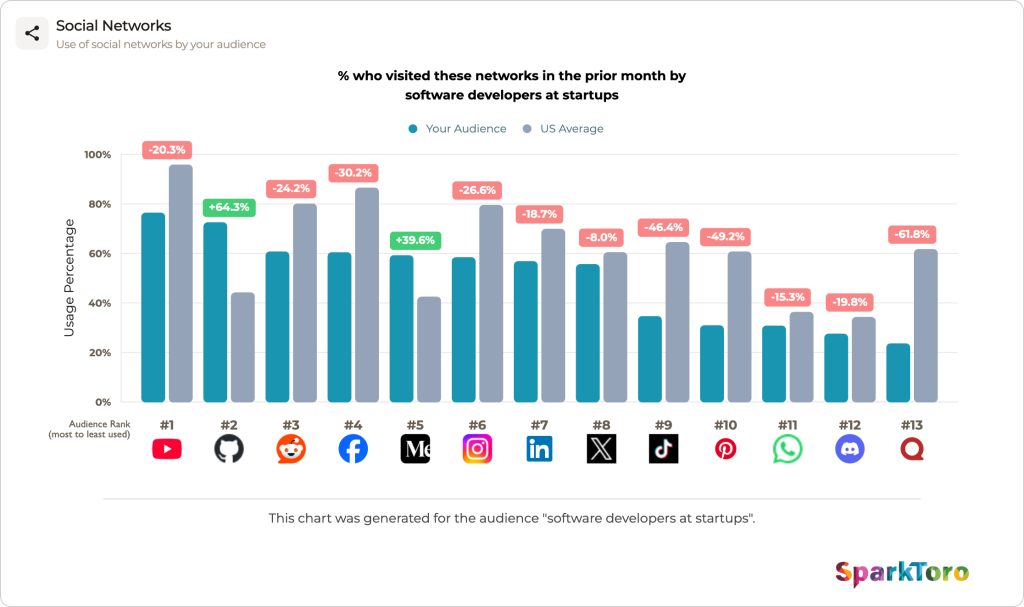
So what is the platform? GitHub. A full 72.4% of this audience uses GitHub, and they over-index by 64%. It’s the most-used social platform here after YouTube, and the most over-indexed one at any real scale. Marketers almost never put GitHub on a media plan — you can’t exactly buy a banner ad on a pull request — but it’s where developers actually spend their attention and build their trust.
A few more that reward a closer look:
- Medium over-indexes by 40% — developers read and write long-form technical posts there.
- Dribbble over-indexes by 60% — that’s the designers and design-engineers in the building.
- Slack over-indexes by 13% — likely workplace use, but a signal that community lives in private channels.
- YouTube is still the single most-used platform (76.3%). It under-indexes slightly, but the absolute reach is too big to ignore for top-of-funnel.
And the platforms marketers love to default to? They all under-index, and not by a little: TikTok (−47%), Pinterest (−49%), Quora (−62%), Facebook (−30%), Instagram (−27%).
Developer attention is earned, not bought. You reach this audience by being genuinely useful on the surfaces they already trust — a great open-source repo, docs that don’t make them want to scream, a tool that does one thing well, an honest technical post — not by retargeting them around the open web.
Insight #3: Whatever the platform, the conversation is about careers, comp, and AI
Now look at what this audience is actually prompting AI about, and it’s not “best CI/CD pipeline.”
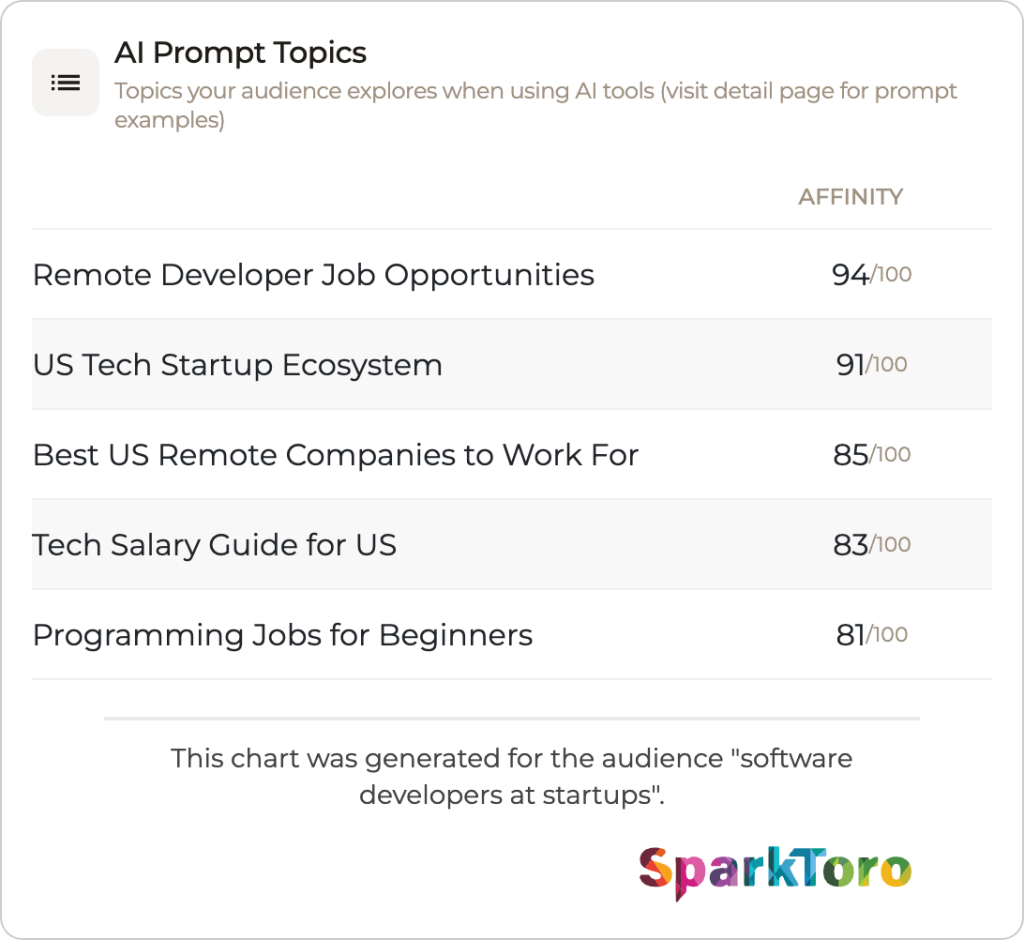
It’s jobs. The top AI prompt topics read like a career-coaching syllabus: Remote Developer Job Opportunities (94 affinity), US Tech Startup Ecosystem (91), Best US Remote Companies to Work For (85), Tech Salary Guide for US (83), Programming Jobs for Beginners (81). “AI Tools for Software Developers” shows up too (58) — but the common theme is career, compensation, and remote work.
The search keyword data tells the same story: “remote developer us,” “tech jobs usa,” “startup software jobs,” “software engineer positions,” “entry level developer jobs,” “startup equity calculator,” “faang vs startup pay.”
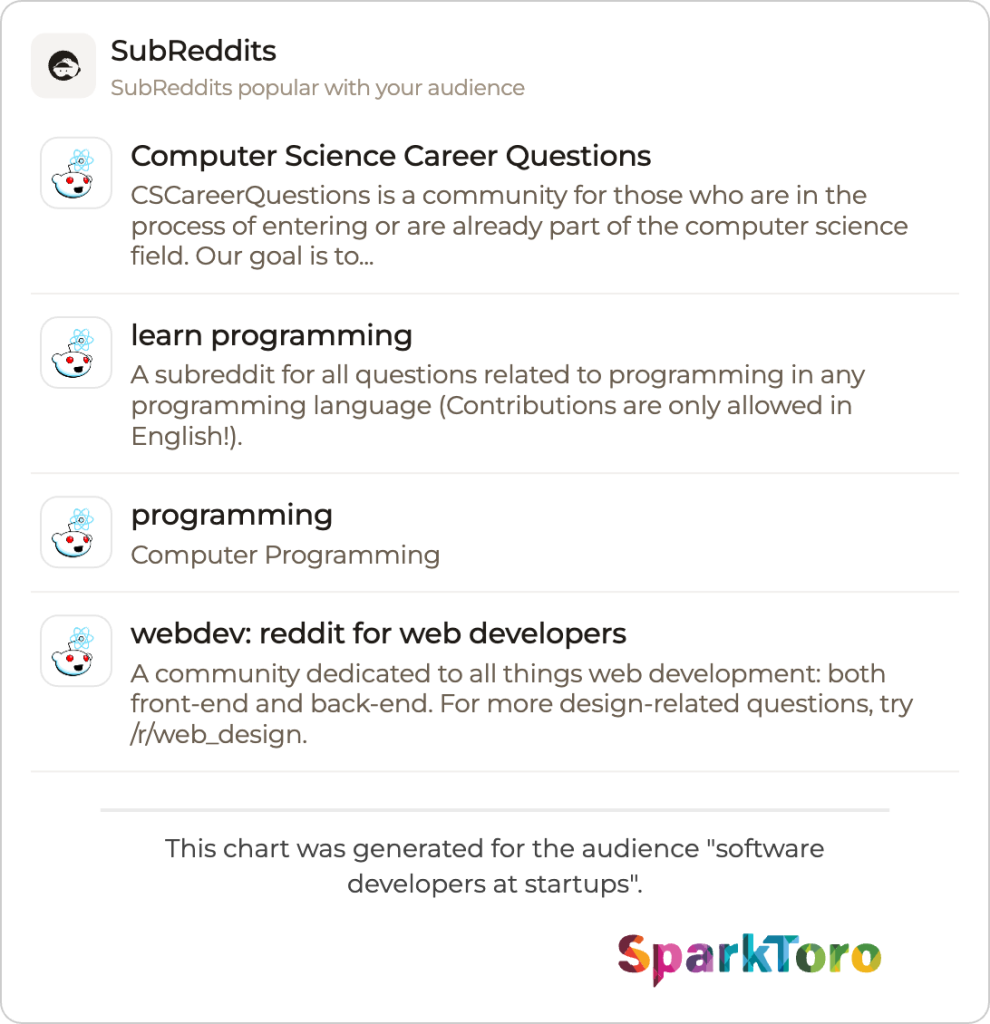
And the communities back it up. The #1 subreddit for this audience is r/cscareerquestions — a perfect 100 affinity — followed by r/learnprogramming, r/programming, and r/webdev, and then the indie/startup cluster: r/IndieDev, r/startups, r/EntrepreneurRideAlong. Career anxiety, skill-building, and startup dreams, all in one feed.
On podcasts, the affinity list is almost entirely AI shows — Latent Space (the AI Engineer podcast), Practical AI, The AI Daily Brief, Last Week in AI, Software Engineering Daily. If you want to buy your way into this audience’s ears, AI-engineering podcasts are the lane, full stop.
Here’s another nugget of wisdom: this audience actually skews experienced — roughly two-thirds have 6 to 20 years in the field — which sits in fascinating tension with all that entry-level, job-search-flavored search behavior. Read it as a defining feature of this world: developers are perpetually evaluating their next move, their comp, and their stack, no matter how senior they get. Comp, career, and AI tooling are evergreen hooks here.
Developers don’t want to be marketed to. They’re researching their careers and their tech stack. Show up with content that genuinely helps with those two things, and you’ve earned a hearing.
A transparent note on the data
In the spirit of transparency we owe you: “software developers at startups” is interpreted by SparkToro through affinity, not a verified headcount filter. About 72% of this audience sits in software, IT, or internet companies (48% in software specifically), which is a tight, on-target cohort — but there’s no literal company-size cut, so “at startups” really means “developers who index toward startup and indie-tech interests.” If you wanted a stricter definition, you’d refine the description further.
Also: a couple of the niche tools in that Search & AI panel (Kagi, Phind, searchcode, you.com) post eye-popping over-index numbers that are artifacts of tiny national baselines — directionally telling, not precise. We left the broad cohort as-is because it better reflects the universe a dev-tools company is actually trying to reach.
What we’d actually do with this
Here’s the 30-minute exercise you can run today.
Pull an audience research report. Take the top sources from Search & AI Tools, Social Networks, Subreddits, Podcasts, Keywords, and AI Prompt Topics. Lay them next to your current plan, and ask:
- Where are you already spending?
- Where are you creating content?
- Where are you trying to earn mentions?
- Where are you completely absent?
Then, depending on your seat:
- A demand gen marketer might notice that a plan built on LinkedIn ABM and retargeting is fighting the data — and test developer-native surfaces instead: open source, docs-as-marketing, an AI-engineering podcast sponsorship, or a genuinely useful free tool.
- A content marketer might build around careers, comp, remote work, and AI tooling — the things this audience is already searching and prompting for — instead of the topics we wish they cared about. (Bonus points if those terms have decent search volume.)
- A brand marketer might start checking how the product shows up in Claude and Perplexity specifically — not just ChatGPT — since Claude is the tool this audience reaches for roughly 4x more than average.
- A partnership marketer might court AI-engineering podcasts and credible career/indie creators before chasing the biggest, most obvious developer brands.
- A product marketer might rewrite the landing page in the language straight out of the keyword and prompt data. Developers can smell positioning-speak; a good product marketer would mirror how they actually describe the problem.
And a CEO or CMO might ask the harder question:
Are we marketing to developers the way we’re comfortable marketing — or the way developers actually learn, search, and decide?
Audience research won’t make developers love marketing. But it’ll stop you from spending a quarter’s budget shouting on the channels they tuned out years ago — and point you toward the few places they’re actually paying attention.