Inimitable Product is the New “Make Great Content”
For 25 years, Google told websites to “just make great content,” and they’d sort out the rest. This advice was incomplete, problematic, and reductive, but also… sorta true. If you made 10X Content in 1997, 2007, or 2017, it often worked (at least, so long as you *marketed* that 10X content).
But, no more.
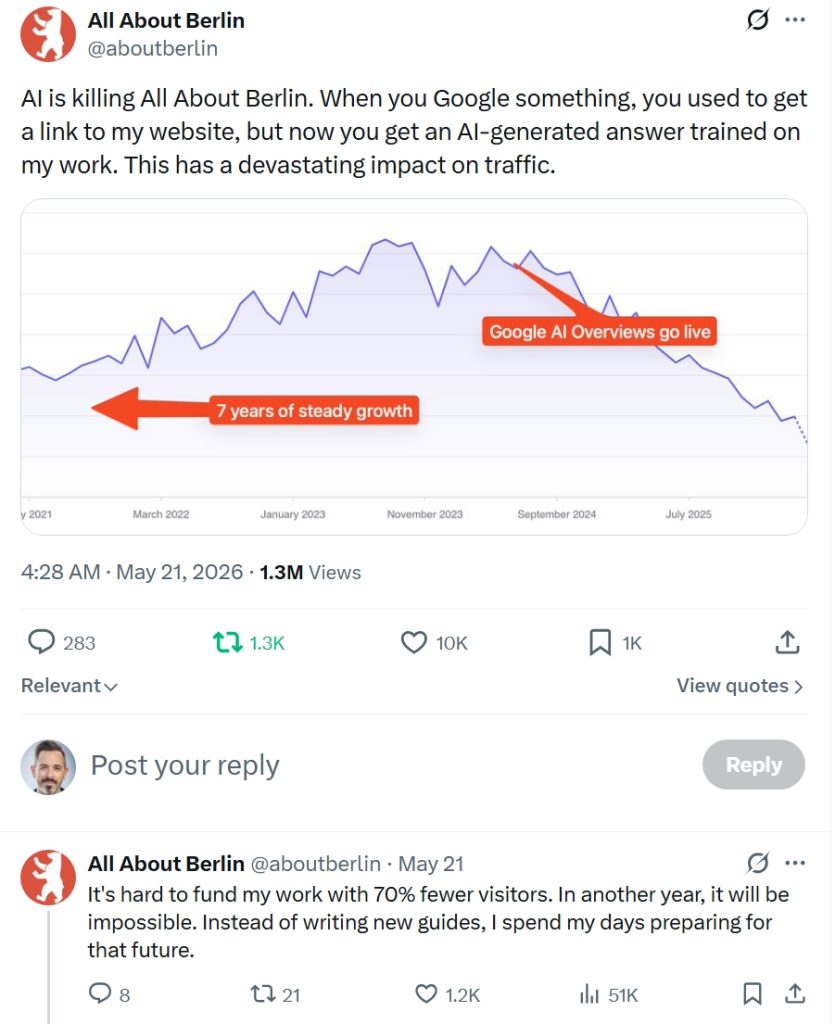
Google’s future is no longer indexing the web and making information universally useful and available, it’s wholesale, intentional, unrepentant, unfettered-by-the-law theft: the great digital enclosure of publishing. They haven’t been shy about this, but they’ve never been as loud and proud as they are now. “We’re going to ruin the Internet,” is Google’s new rallying cry, though they’ll frame it as “AI search for the agentic era” (a meaningless jumble of words reminiscent of Andreesen-clueless autocomplete).
Google’s plan is elegant, simple, and evil:
- Crawl and index the web’s content
- Use their mafia-like power to force a prisoner’s dilemma paradox (i.e. if you don’t let them index your stuff, they’ll just take it from someone else and reward them with the scraps of traffic, branding, and potential business)
- Use that content to train their models/power their answers
- Make your work a redundant commodity (because everything published can now be found in a more convenient, familiar format inside Google’s interface)
- Only send clicks when businesses either:
A) Pay them for ads
B) Offer something Google can’t provide directly in their AI-powered answer interface
You can see this for yourself in Google’s preview of their new search box:
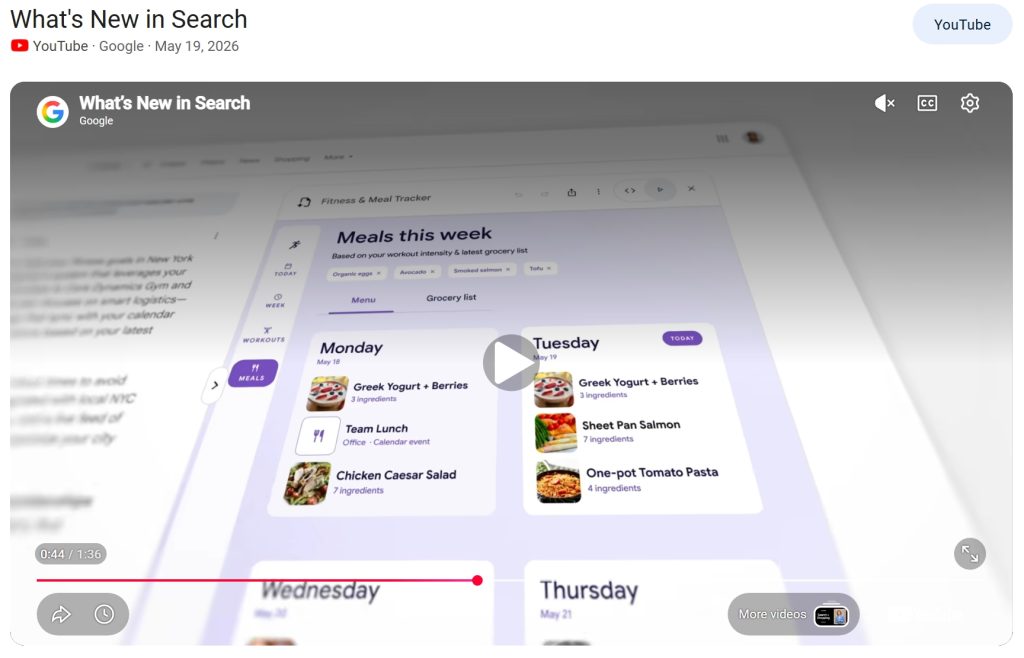
Those fitness plans, recipes, structured calendars, and clever tips aren’t made by Google. They’re stolen. Repurposed. Averaged. And then presented as the search monopolist’s own work.
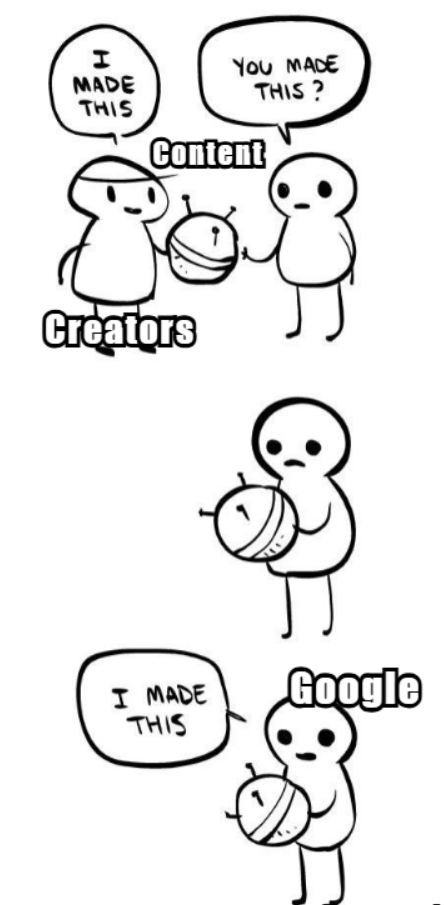
AI is, statistically, the least trusted, most hated technology of our lifetimes, but popular sentiment is doing nothing to halt its progress among the tech, business, and finance elite. Google’s embraced it whole-hog, and may even be willing to sacrifice their core ad revenue (through reduced clicks and CTR) to promote a world in which they and they alone own your Internet experience. Google no longer wants to be the gateway to the web. They want to be the web. And they may just have the power to force it down the throats of even the skeptical and unwilling billions of Internet users who hate AI, don’t trust Google, but cave to convenience.
Businesses and Creators Have But Two Solutions
Solution 1 is long-term. It’s going to take collective action, mostly voting, mostly in the United States, and I cynically suspect it won’t happen. Citizens would need to support politicians who’d empower the Department of Justice and FTC, hire states’ attorneys general, and nominate/elect judges to hold big tech companies accountable for the works they’ve stolen, trained upon, and presented as their own. Monopolies would need to be broken up (not slapped on the wrist with penalties that will only consolidate the industry’s exploitative power). Self-preferencing would need to be made illegal. And Americans, even as they slip into deeper economic distress, continue to vote like temporarily embarrassed billionaires. Soon, even overwhelming vote-count victories may not matter in a country where gerrymandering rules.
Solution 2 is short-term. It’s what every digital marketer, content creator, and business owner historically reliant on traffic from search must do to stay alive: build inimitable products.
Despite all the seeming wonders of Google’s new AI-powered, agentic, buzzword-laden search engine, it cannot invent ultrasonic chef’s knives. It can’t tailor a made-to-measure suit with an ocean of whimsical personality. It can’t thoughtfully curate gift boxes from local makers. It will never lovingly prepare the meal of your life. It won’t refine pottery techniques for thousands of years to make the perfect vase. Or paint scenes of everday life with the colors of time. Or source WWI-era Armagnac in order to serve your 98-year-old grandfather something older than him. Or hand-carve and paint tiny creatures who keep your trinkets safe. Or fill giant warehouses with stories and Objets d’art to delight visitors of all ages. It won’t mow your lawn or fix your roof or service your printer or manage your 401k.
To make inimitable products, you’ll need to:
- Uncover the overlap in what you’re passionately capable of creating, what other solutions in the market fail to offer, and what people in that market desperately want.
- Create that overlapping thing in a way that’s designed for Zero Click Marketing: it can be shown via short-form video, amplified with just a few images, easily described by a rabid fan, and made enticing though a brief summary atop an AI-answer.
- Get the word out about your product through the channels where your audience pays attention: Social media, PR, advertising, search engines and AI answers (which are becoming one), and word-of-mouth (which may soon return to its 20th-Century position as the MVP of marketing channels)
I will never stop mourning what we lost: a web with powerful incentives for anyone and everyone to create great content. A web that, as a result, brimmed with useful information, incredible storytelling, and artful records of every kind (among, of course, millions of pieces of mediocre junk). It is a tragedy that American voters and the politicians they elected ceded this world to a few giant, disgustingly wealthy corporations in exchange for feigned subservience to their proto-fascist agenda.
But I’m also hopeful that this change, as brutal and wrong as it is, will forge a new incentive for a new kind of creation. The creation not of content, but of product. Physical goods, software, services, experiences… these are your only defense against Google’s ambitions. If you offer something that cannot be disintermediated, cannot be replicated with pixels or words on a web page, and is desperately sought-after by people who’ve heard about it, you might just be safe from the Zero-Click Web apocalypse Google’s so desperate to bring about.
So Content Marketing is Dead?
Am I ready to fully declare the death of content marketing? The death of content creation for the web? Not quite. I’m writing this piece on a blog, aren’t I? 😅 But the writing’s on the wall. Only a fool would double down on “make great content” (10X, 100X, or 10^100X) as the path forward.
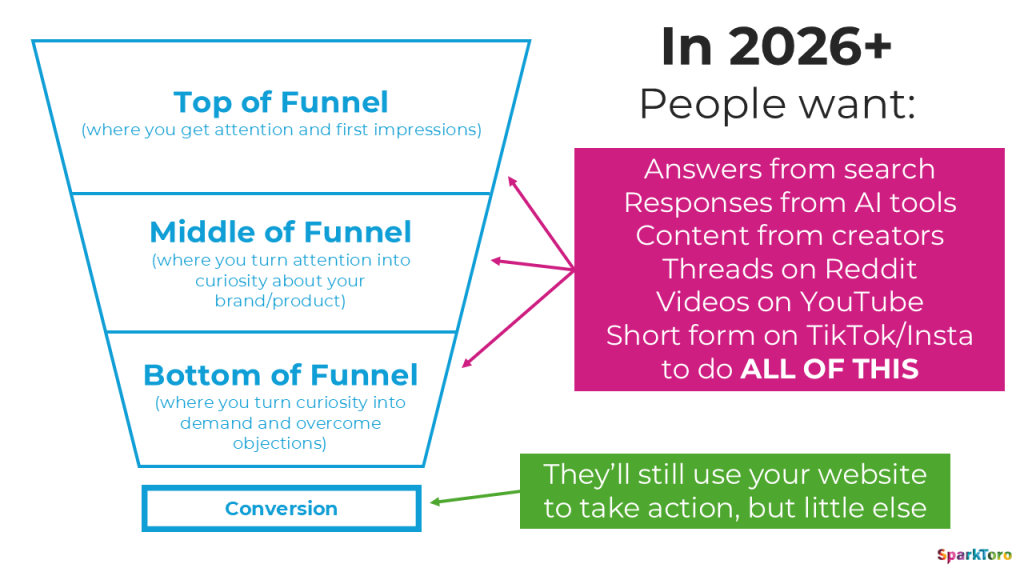
If I had to give some (nearly) universal advice to the web’s creators, it would be this: ignore traffic. Make inimitable products. Shift your priorities away from “great content” on your own site and toward “great marketing” on the platforms where your audience pays attention. Influence is the new traffic. Impressions and engagement are the new top of funnel. Branded search volume is the new middle. Sales remains the true measure of success.
There’s one final, brutal takeaway from this dastardly upending of the status quo: Inimitable products may be defensible moats on which to build a web business, but inimitable content is not. Content as product is dying, and that death spiral is accelerating. The New York Times is just a games platform with a vestigial news and content appendage. Bloomberg makes money on terminals and uses the profits to fund their content machine (which then markets the business of commodities trading and helps to sell their inimitable product: the terminal).
Not every Substack newsletter will die. Not every Patreon creator will fail. Not every independent blog or subscription-funded publisher will go bankrupt. But most will need to find an inimitable product, a non-content-based product, to survive and thrive.
So What is Even the Point of Publishing Anymore?
Why does this blog post exist? Or this blog for that matter? If the things I’ve told you above are true, am I a hypocrite for writing this? Just another sleazebag marketer trying to sell their book?
Here’s why I still publish (sometimes), and why you might continue to do some (though probably much less):
- To influence search engines and AI tools (who will still need sources to train off and pull from for their traffic-stealing answers).
- To have a home base for an idea; something that can be cited and quoted and screenshot’d and referred back to as the original source, even if/when the platforms decay.
- To have a place where the most loyal, rabid, excited fans and subscribers can still access this content in its entirety, in its intended format, even if that group is 1/100th the size it once might have been.
- To distribute via email — one of the last owned channels where big tech’s power hasn’t yet removed value.
- To exercise longer-form, more thoughtful, bespoke creation of an idea that’s bigger than the few hundred character limit of social media. And, in doing so, illustrate that ability to those few people with longer attention spans, deeper care about the problem, and/or an incentive to consume something fully.
I expect this post to receive <5,000 visits, <500 from search, and <100 people who read every word. But if they’re the right ones, and if the piece (or the little bits of it that are re-posted/quoted/cited) creates external influence beyond that, it may still be worthwhile. Especially since, living behind this content, funding its creation, is an inimitable product.