Zero-Click Searches: Highest in the UK, Lowest in Germany, and France has the Most Efficient Searchers
Last week, we published data in concert with Similarweb showing the latest rates of Google’s Zero-Click Searches in the United States. As promised, we’re following up with that same data pulled from Similarweb’s mobile + desktop clickstream panel for 5 additional countries:
- The United Kingdom – with the highest rate of Zero-Click Searches in this analysis
- France – whose rate of search-session ends suggest they’re especially efficient searchers
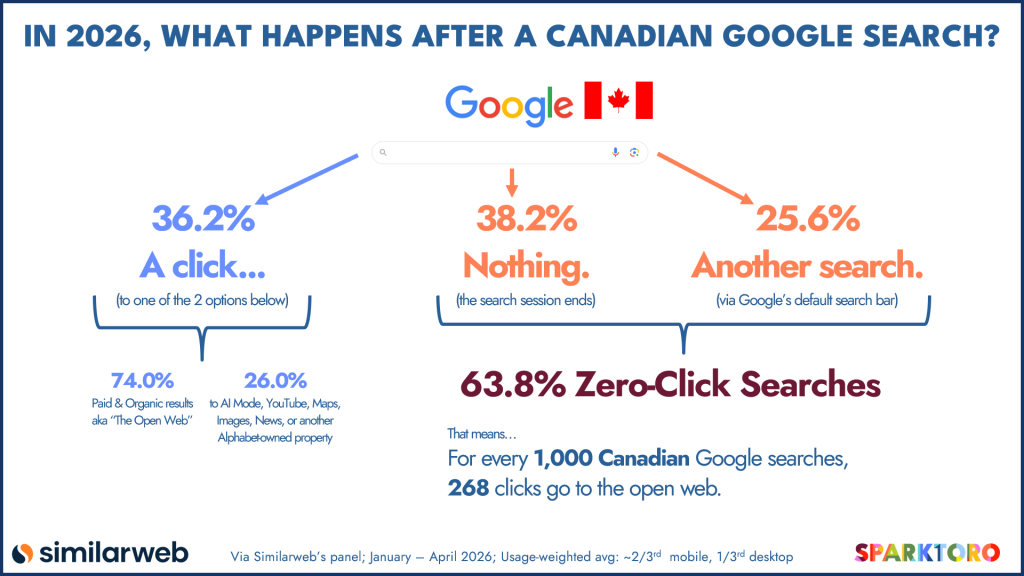
- Canada – right in the middle of the pack on clicks and subsequent searches
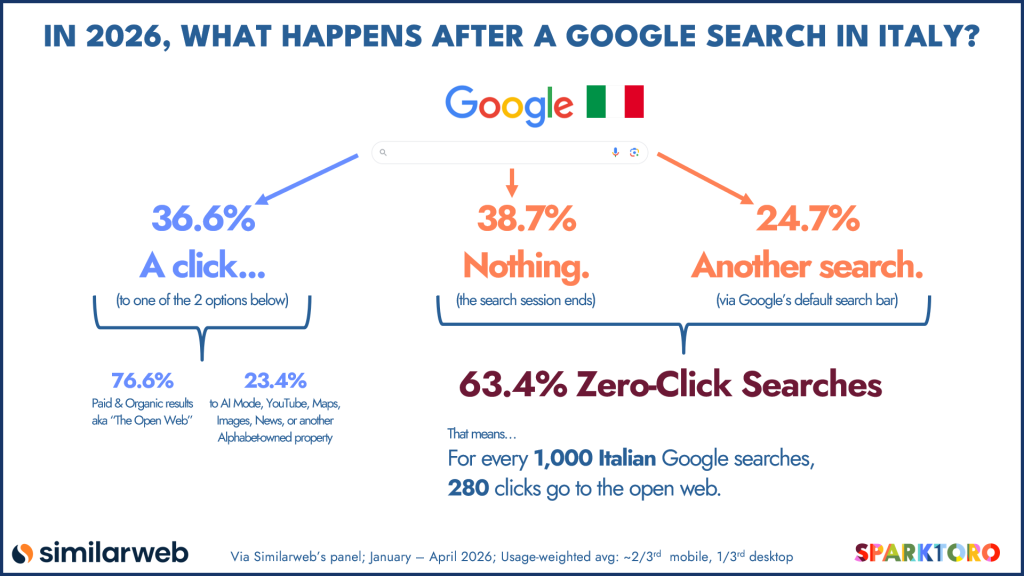
- Italy – similar to Canada, they sit near the median
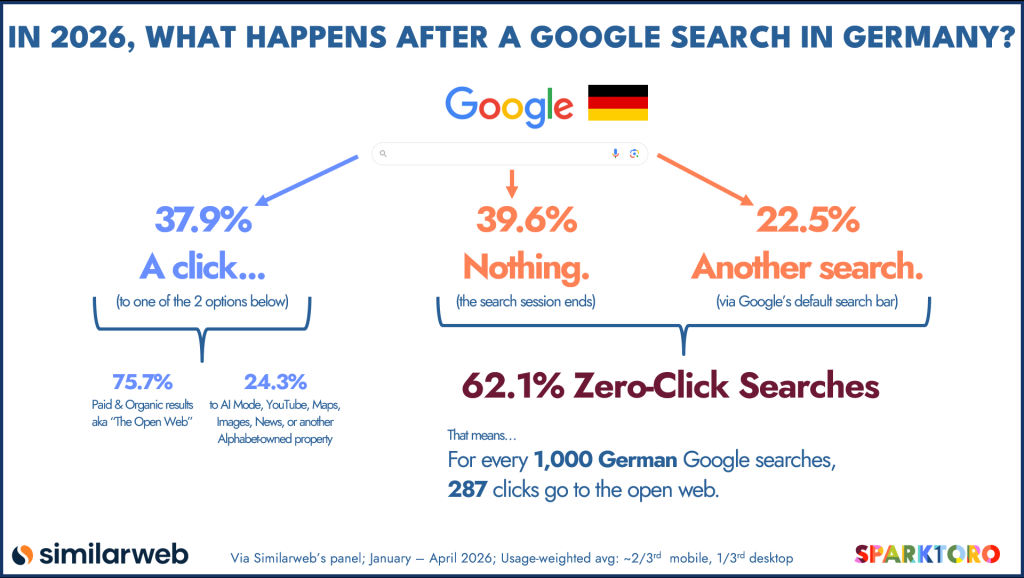
- Germany – with the lowest rate of Zero-Click Searches and the highest percent of searches that still end with a click
Here’s a comparison chart showing the primary three metric for each country’s Google searchers:
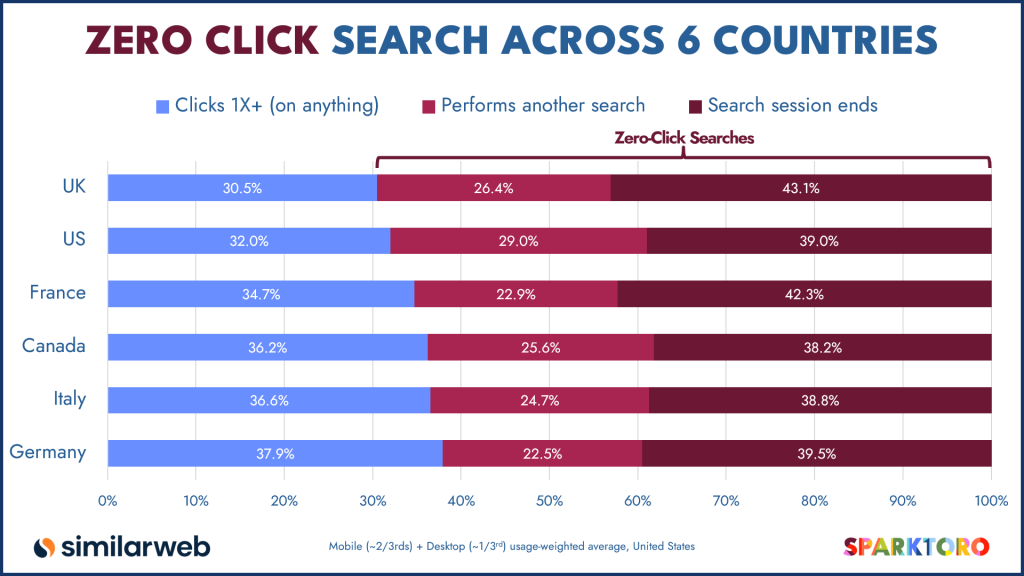
I’ve sorted the group from highest (UK) to lowest (Germany) rate of Zero-Click Searches, and it’s quite a spread: Germany’s Google searchers click at rates more than 20% higher than those of the United Kingdom. It’s possible that this is related to the EU’s restrictions and penalties levied against Google for self-preferencing behavior. But, it’s equally possible this is cultural, linguistic, or driven by UX/feature options within the German Google experience.
Next, I’ve created explanatory maps of what happens after a search is performed in each of this countries (similar to the chart I made for the United States).
Let’s start with Germany and their high CTR on results:
Next, a look at Italian Google searchers:
Third, Canada, who’s right in between the US and EU countries on clicks vs. Zero-Clicks:
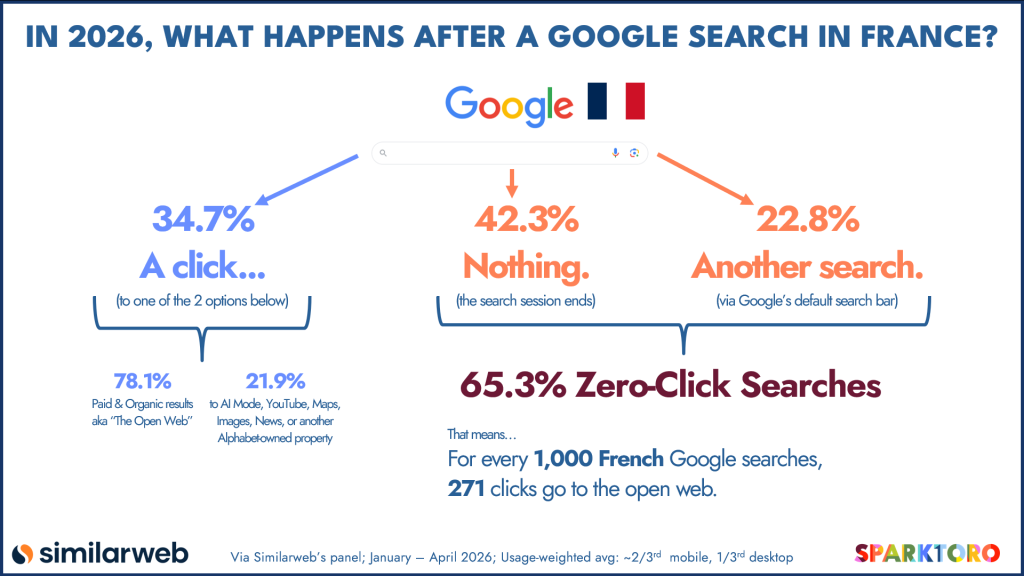
Penultimately, France, with an especially high rate of session ends following a search query:
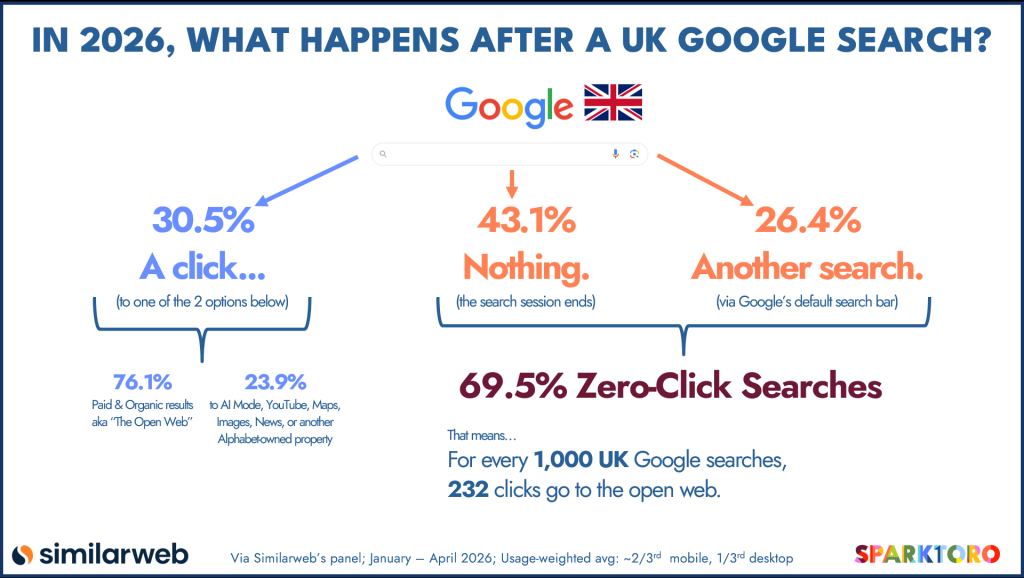
And last, the United Kingdom, where clicks are even less common than in the United States:
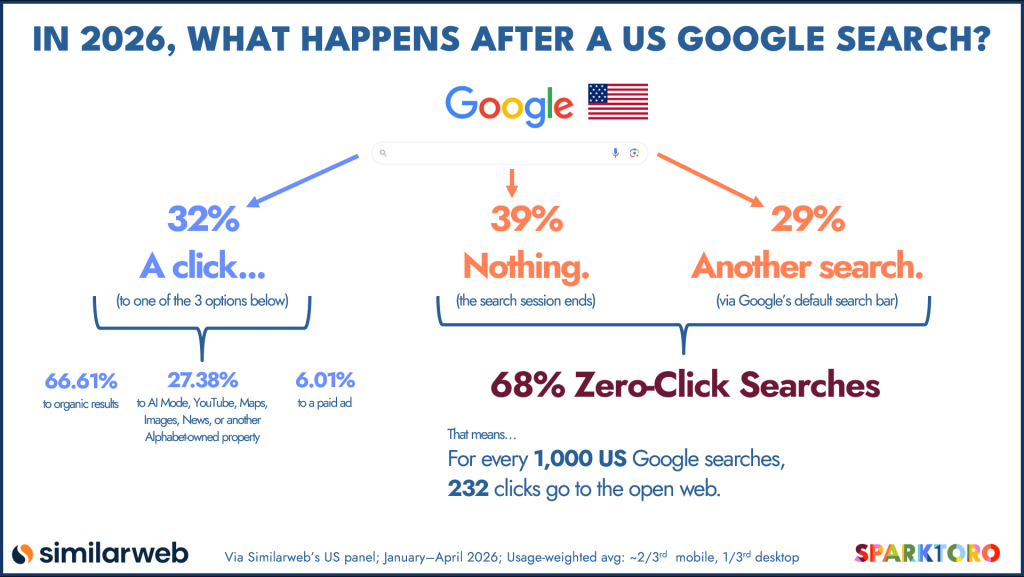
For posterity and ease of comparison, I’ve also included the United States below:
And for those seeking this in unadulterated mathematical format:
| Germany | Italy | Canada | France | US | UK | |
| Clicks 1X+ | 37.9% | 36.6% | 36.2% | 34.7% | 32.0% | 30.5% |
| Zero-Click Searches | 62.1% | 63.4% | 63.8% | 65.3% | 68.0% | 69.5% |
| Performs another search | 22.5% | 24.7% | 25.6% | 22.9% | 29.0% | 26.4% |
| Search session ends | 39.5% | 38.8% | 38.2% | 42.3% | 39.0% | 43.1% |
| % of clicks to Alphabet-owned sites | 9.2% | 8.6% | 9.4% | 7.6% | 8.4% | 7.3% |
| % of clicks to organic + paid results | 75.7% | 76.6% | 74.0% | 78.1% | 72.3% | 76.1% |
| Clicks to open web per 1K searches | 287 | 280 | 268 | 271 | 231 | 232 |
My big takeaways:
- The EU’s anti-self-preferencing legislation may be working to help keep EU searchers clicking, but it’s hard to know without more robust testing mechanisms
- The UK and US both having such high rates of Zero-Click Search could be seen as cultural or linguistic, except… Canada! Canadian CTRs being statistically closer to the major European countries suggests there are other variables at play.
- The least amount of fluctuation is on satisfied searchers who end their session. It’s only ~4 points of difference between the highest (43.1% in the UK) and lowest (38.2% in Canada)
- No country still sends 300+ clicks to the open web per thousand searches. It’s a Zero-Click web; we’re just scrolling in it.
Methodology
Data for this study comes from Similarweb’s desktop and mobile web panel for January – April 2026 (US). Please read the US data post for details on methodology. The following also apply to this particular study:
- A full breakdown of mobile organic vs. paid CTRs wasn’t available for this study due to lacking data about the relative mobile vs. desktop CTRs for paid ads vs. organic results in Google in countries outside the US. Thus, unlike the US study, these two have been grouped in the stats here.
- The number of clicks/visits sent per 1,000 searches is likely slightly undercounted due to some searchers clicking more than one result.
- The number of searchers who “searched again” only includes searches in the default search interface. A searcher who opens a YouTube search, Google Maps search, Google Images search, etc. would be counted as “clicking on something” inside of Alphabet’s ecosystem.
It’s (once again) worth noting that this data is not inclusive of the Google mobile search application, but rather mobile searches within the browser. Given that Google’s use of zero-click features happens even more aggressively within the search app, it’s likely the percentage of zero-click searches is even higher than what we’ve found here.
Licensing, Usage, and Closing Notes
Feel free to quote, cite, and use the images from this report anywhere you’d like so long as you provide linked credit back to this post and to Similarweb.com as the data source provider.
Thank you to SparkToro’s Amanda Natividad and Kristy Bolsinger, and Similarweb’s Sam Sheridan and Adelle Kehoe for their respective help editing this report and providing the data/validating my analysis.
No AI was used in the authoring of this post (all mistakes are mine alone). I consider it disrespectful, lazy, and morally dubious to use AI for such purposes and thus, nothing I write employs it.