Audience Affinity vs. Traffic: Why High-Affinity Media Belongs in Your Earned Media Strategy
If you’ve been building media lists by zeroing in on the sites with the biggest domain authority and traffic, you’re not alone. For years, the default playbook was to pitch the publishing giants and let their syndication networks carry your story far and wide. But bigger doesn’t always mean better, and the highest‑traffic sites often reach everyone except the people you most want to reach.
That’s where SparkToro’s audience affinity comes in. Domain authority and traffic are useful trust signals, but SparkToro helps you find the places your buyers already visit, follow, read, watch, or listen to. Instead of chasing vanity metrics, your brand can hone in on the websites, social networks, podcasts, and channels whose audiences most closely resemble your own. While content is still king, relevance is queen if you want to build authority in the most relevant niches that attract qualified visitors who convert.
To further our understanding of these hidden influencers across the Internet, Fractl tapped SparkToro’s data to see where hyper-specific audiences across 8 industries spend their attention online. We looked at websites, YouTube channels, podcasts, and subreddits, then ranked each outlet by audience affinity score rather than traffic.
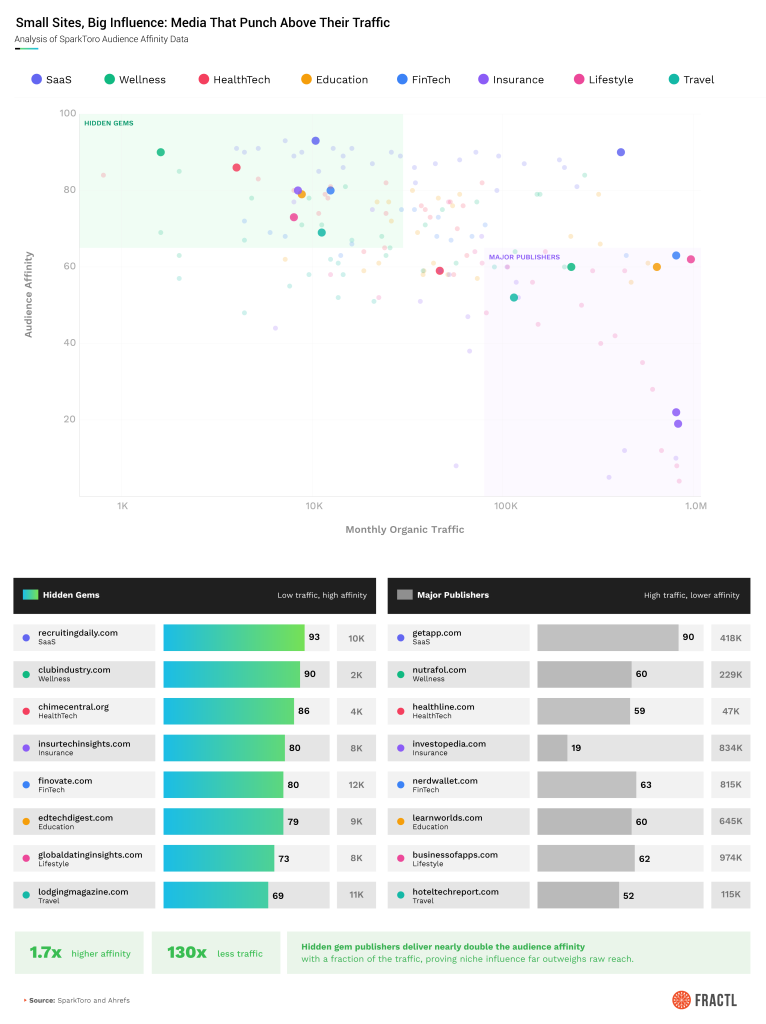
What we found surprised our clients, and will likely surprise you, too: The “hidden gem” publishers (largely comprised of niche outlets with modest monthly traffic) scored disproportionately high in audience affinity. In fact, hidden gem publishers delivered 1.7x higher audience affinity than major outlets, despite attracting 130x less traffic. In other words, a placement on a site with 5,000 monthly visitors could do more to reach your buyers than a feature in a mainstream publication with 500,000 readers. Across industries, the pattern was remarkably consistent.
The good news: These niche influencers typically receive fewer pitches, making it easier to reach them. So, let’s dive in.
Small sites, big influence
So what do these “hidden gems” actually look like? When we drilled into SparkToro’s data, we saw a clear pattern: Publishers with 5K–10K monthly visitors and domain ratings in the mid-60s to low-70s often have very high audience affinity. These aren’t the sites that show up at the top of your SEO tools, but they consistently attract the right people—your people.
On our scatterplot, they formed a tight cluster of high‑affinity, low‑traffic outlets, while the household names sat on the opposite end:
Across industries, the examples were striking:
- SaaS: RecruitingDaily.com scores 93 in audience affinity with about 10 K visitors, rivaling GetApp.com’s 90 affinity at 418 K visitors.
- Insurance: InsureTechInsights.com (8 K visitors) scores 80, whereas Investopedia.com (834 K visitors) scores 19—100× more traffic for a far less relevant audience.
- Travel: Even lower‑scoring outlets like LodgingMagazine.com outperform several well‑known travel publications in audience affinity.
The takeaway: the placements your digital PR team overlooks might be the ones that actually move the needle. Now, we’re not suggesting you abandon mainstream media entirely. Brand visibility still depends on a diversified network of branded web mentions. What’s changed is how we define “authoritative.” Monthly traffic was once a rough proxy for audience quality. In a world where discovery happens through search results, social feeds, communities, and AI‑driven answers, reach and relevance are no longer the same thing. You need both.
That means pairing authoritative mainstream placements (for scale and SEO) with high‑affinity niche publishers that put your story in front of the buyers who matter most. Each high‑affinity placement reinforces the same brand associations with the same audience across multiple trusted sources, building the kind of repetition broad‑reach coverage can’t deliver on its own. And don’t stop at publishers: community‑led platforms—YouTube channels, podcasts, subreddits—are where these audiences spend time. Reach them there, and you’ll see just how powerful small sites can be.
YouTube and Reddit drive high audience affinity across industries
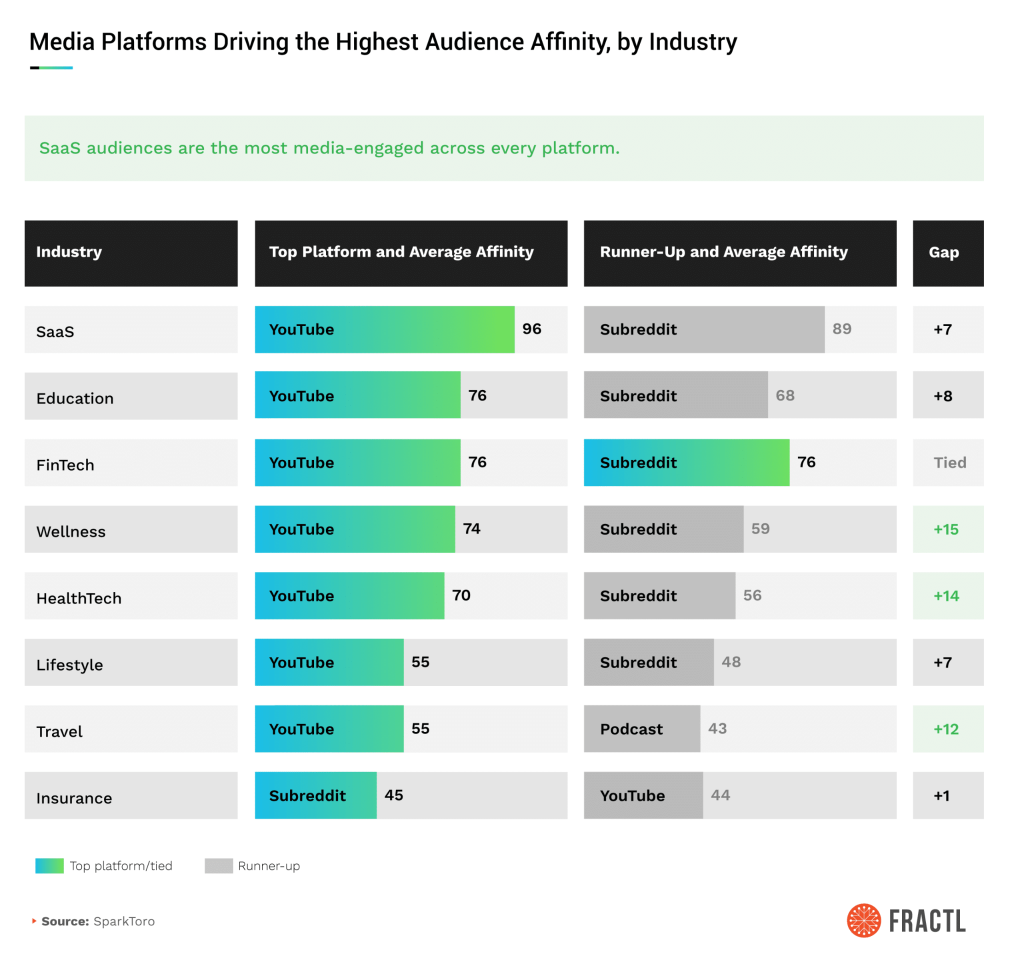
When we widened our lens from publishers to community‑led platforms, the pattern was impossible to miss. YouTube was the top destination for high‑affinity audiences in seven out of eight industries, and Reddit was the runner‑up—except in Travel, where podcasts edged it out, and in FinTech, where YouTube and Reddit tied. In other words, your buyers aren’t just reading; they’re watching, listening and discussing in niche communities.
Some highlights from the data:
- SaaS: RecruitingDaily.com scores an audience affinity of 96 on YouTube and 89 on Reddit—a 7‑point gap, the largest of any vertical for the top two platforms.
- Insurance: Reddit takes the lead at 45, with YouTube just behind at 44.
- Wellness (+15) and HealthTech (+14) show the widest gaps between first and second place, signalling that their audiences are especially concentrated on YouTube.
- FinTech: YouTube and Reddit are neck‑and‑neck at 76 each.
If your earned media strategy stops at pitching publishers, you’re leaving niche-relevant authority and influence on the table. To reach these high‑affinity hubs:
- Collaborate with niche YouTubers to interview your subject‑matter experts, review relevant products or services, and discuss proprietary data when you have it.
- Join conversations in relevant subreddits, sharing actionable insights and resources—never promotion—for the questions your buyers ask.
- Pitch your subject‑matter experts as guests on podcasts your audience already loves.
This diversification isn’t just about reach. AI‑driven discovery is reshaping how people find and trust brands. Being present where your audience watches, listens, and talks gives you an edge that traditional placements alone can’t match.
Your earned media strategy shapes how AI describes your brand
Consumer AI adoption isn’t slowing down—according to Fractl’s latest research with Search Engine Land, 70 % of consumers report using AI for search more than they did a year ago. Yet only 24% of marketers monitor their brand visibility in LLMs, and even fewer understand the signals that influence brand visibility on these platforms.
Earned media makes up a huge part of that signal, and the research backs it up:
- AI visibility comes from earned media: Muck Rack’s “What Is AI Reading?” report showed that 95 % of AI citations come from non‑paid media, and 89 % come from earned media.
- Third‑party placements multiply your chance of being cited: Stacker’s research found that distributing your story through third‑party outlets can increase AI citation visibility by around 325 % compared to publishing it only on your own channels.
- Branded web mentions drive visibility: Research from Ahrefs shows that AI systems pay more attention to brands that appear across a diverse set of trusted, topically relevant sources, through signals such as branded web mentions and branded anchors—not just those with well‑optimized websites.
The takeaway for marketing teams
The research is clear: bigger isn’t always better. In today’s fragmented, cross-channel discovery landscape, the brands driving the most defensible visibility are laying these three things together:
- Authoritative mainstream placements to build trust and authority signals.
- High‑affinity niche publishers to establish category relevance and audience affinity.
- Cross‑channel distribution to repurposing their best content to extend their reach and strengthen their brand mentions and authority.
If you keep chasing vanity metrics, you’ll keep missing the hidden gems that quietly shape decision‑maker attention.
If you want to see which outlets and communities are punching above their weight, and how to tap them, check out our full report and start building an earned media strategy that drives brand authority and visibility across channels.
About the Author
Kelsey Libert is the co-founder of Fractl, a research-driven content marketing and digital PR agency known for helping companies grow brand visibility through data journalism, earned media, and conversion content. She has led thousands of campaigns for brands ranging from funded startups to Fortune 500 companies, and her industry research has been featured in Harvard Business Review, Inc., Search Engine Land, and leading conferences.