Creating and Promoting Were Never the Same Decision
I’ll admit I’m kind of a thinkboi (gender neutral). I’m often more interested in the philosophies behind marketing — how we pick our campaigns, which ideas are worth exploring — than in the campaigns themselves. So when Tim Soulo asked me a question on the Ahrefs podcast that I couldn’t immediately answer, I did what any thinkboi would do: I’ve been turning it over ever since.
The question was this:
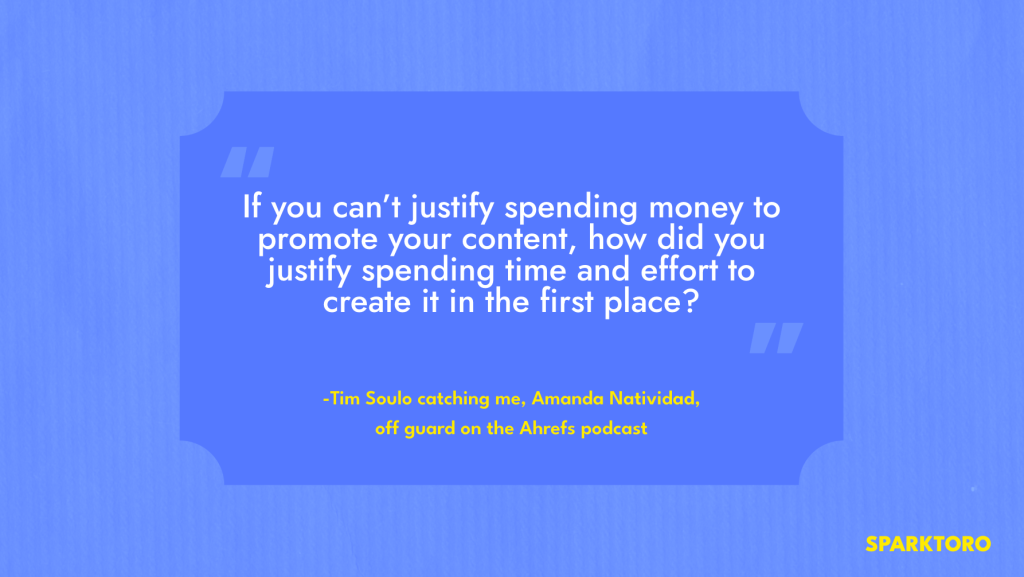
If you can’t justify spending money to promote your content, how did you justify spending the time and effort to create it?
After all, if an idea is valuable enough to research, write, edit, publish, and distribute organically, shouldn’t it be valuable enough to advertise?
It’s a logical question that caught me off guard because it pokes directly at the thing I’m most susceptible to believing. I’m the zero-click person. I’ve bolstered my career on the argument that you should give your best thinking away for free, meet people where they already are, and trust that it comes back around. Tim’s question essentially asks whether that philosophy is sometimes just a comfortable way to avoid the accountability that paid promotion forces on you. Because when you put dollars behind an idea, you have to name the audience, the message, and the outcome you expect. When you let it spread organically, you can skip all three and call it strategy. (Boom. Self-roast!)
I’ll address the zero-click elephant in the room. Yes, “the idea matters” can absolutely be an excuse. Marketers use it to justify work that nobody sees, nobody needs, and nobody remembers. We romanticize organic reach. We avoid paid because paid makes us choose. And sometimes we say we’re building impact when we’re really just publishing and hoping. I’ve done versions of this. If you’ve made content for a living, you probably have too. (Roasted you too!)
But the question also brings up an assumption that I don’t agree with: that creating and promoting are the same decision, made with the same unit, answered by the same yes or no. They aren’t.
Creating an idea is a one-time cost that produces a durable asset, and possibly results in even greater idea production over time. And when an idea is good, that idea doesn’t live in a single post — it travels. The same thesis can move through a blog post (ahem, “zero-click content”), a podcast, a webinar, a keynote, a sales conversation, a dozen social posts, a book, and, increasingly, an AI-generated answer. I can take the idea on tour. That tour costs time, but most of its stops are effectively free to me, and each one lets me test and refine the thinking as it moves. Over months and years, the idea becomes part of how people understand a subject. That’s a fundamentally different return than “we spent $500 and generated 37 conversions.”
Paid promotion is a different animal entirely: recurring spend on a single channel. And every dollar behind a campaign is a dollar not spent on another campaign, a customer research project, a creator sponsorship, a new hire, or simply preserved runway. So a paid boost can be a mediocre investment even when the idea underneath it is excellent. The idea being worth creating and the promotion being worth buying were never the same question. One asks whether the asset deserves to exist. The other asks whether this specific channel, right now, is the most efficient way to spend a finite budget.
There’s a second assumption worth pulling apart, too: that confidence in an idea should translate directly into confidence in its commercial performance. But believing an idea is true tells me almost nothing about which audience will respond to it first, which format will carry it best, which channel deserves the budget, whether people are even ready to hear it yet, or whether it will produce any immediate action at all. Some ideas are obvious hits. Others are slow burns that look like duds for a year and then become the thing people cite, repeat, and return to. An idea can be strategically important without being an efficient advertisement.
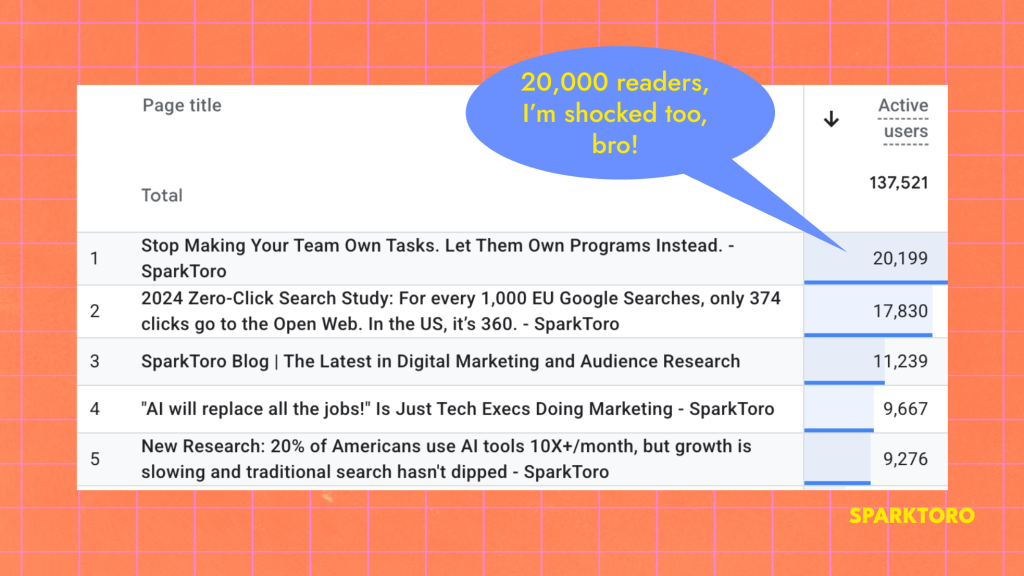
In summer 2022, I knew my “Zero-Click Content: The Counterintuitive Way to Succeed in a Platform-Native World” idea and blog post would hit… though I didn’t know just how hard it would hit. The original Twitter thread got over 2,000 likes and still gets engagement today. What I didn’t know was that a few months later, “zero click content” would start showing up in job descriptions (ugh, I never took a screenshot of this, but trust me, I guess? I hate lying because morals and because unnecessarily increased cognitive load sucks). When I wrote in fall 2024 about why roles/teams should own full programs rather than specific tasks, I thought people and project managers everywhere would share that post. It generally did fine, and then it fizzled out quickly. I figured the concept was too wonky or maybe not even that helpful. But then towards the end of 2025, it picked up steam out of nowhere and became our most read blog post that year with over 20,000 views. (I still don’t know why. If you know, ping me!)
We don’t need to let me off the hook, though. The danger of everything I just argued is that it’s also a perfect rationalization. “The idea is durable, it’ll spread organically, promotion is just opportunity cost” is exactly what I’d tell myself to avoid the harder work of putting money and a measurable claim on the line. So the discipline isn’t in choosing organic over paid. It’s in being honest about which one I’m actually reaching for, and why.
Which is why I think Tim’s question, as sharp as it is, is pointed at the wrong target. The question isn’t:
If you believe in the idea, why aren’t you paying to promote it?
It’s:
What kind of support does this idea deserve?
Sometimes the answer is paid media. Sometimes it’s a webinar, a podcast tour, a keynote, or even a book. Sometimes it’s simply a permanent home on your website, so the idea is there to be found when the right person finally goes looking for it. The obligation was never to advertise every idea I believe in. It’s to give the best ones more than one chance to matter — and to be honest with myself about whether I’m giving them that chance, or just hoping.
Related: I recently explored the opportunity costs behind marketing decisions on the Zero Click Marketing podcast. It’s an 8-minute listen on what we give up every time we choose one campaign, channel, or idea over another.