The Click Is Now Optional. Here’s What Isn’t.
Hold onto your butts. Rand’s got new research and it’s a doozy. With Similarweb’s clickstream panel, Rand found that in the first four months of 2026, 68% of U.S. Google searches ended without a click. Not without a click to your site — without a click to anywhere. Less than a third of searches now send a visit to the open web, to Google’s own properties, or even to a paid result.
If you’ve watched your traffic graphs slope downward and wondered whether it was something you did, I have good news and bad news. First, the bad news: it’s probably not coming back. The good news: it almost certainly wasn’t you.
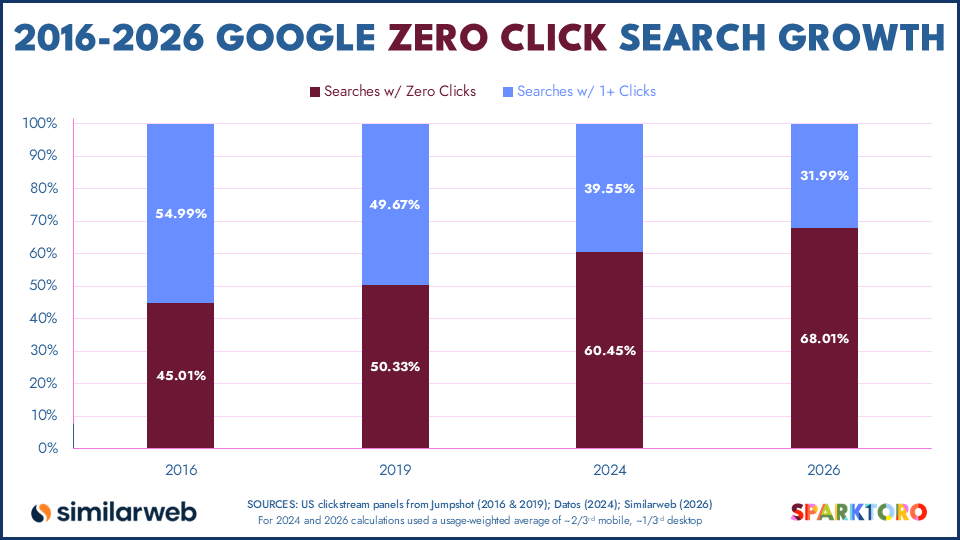
SparkToro first measured zero-click searches back in 2016, when 45% of searches were zero-click. By 2019 it was 49% — the number that really kicked off this whole conversation. In 2024 it crossed 60%. Now, two years later, 68%. That’s 7.5 percentage points in 24 months, which is the fastest acceleration we’ve seen in a decade.
What changed? AI, but that’s only part of it. Google’s AI Overviews, the generated answer boxes at the top of the page, now appear on more than 20% of all searches, and when one shows up, it cuts click-through rate by nearly 60%. Google answers the question on the results page, and the humans who did the actual work to answer that query never get the visit.
This isn’t just hitting hobby blogs. An ongoing Ahrefs tracker of more than 75,000 websites that opted in to share their data — sites with professional marketers actively fighting for every visit — found that even these sites watched Google’s share of their traffic fall about 22% in a single year.
By the way, I recorded a podcast episode on this, so if you want the audio version of these takeaways (not an exact read-through of this blog post), listen to today’s Zero Click Marketing podcast:
First, a skeptic’s note
Before anyone screenshots one of these charts and declares “SEO is dead”—no. Don’t. This is not the AI Mode apocalypse you’ve been warned about. In Rand’s data, AI Mode accounted for about a third of 1% of searches — a rounding error. It’s growing fast, and it may well drive the next chapter of this trend, but it isn’t what got us to 68%. What got us here is a decade of Google steadily building features that keep people on Google.
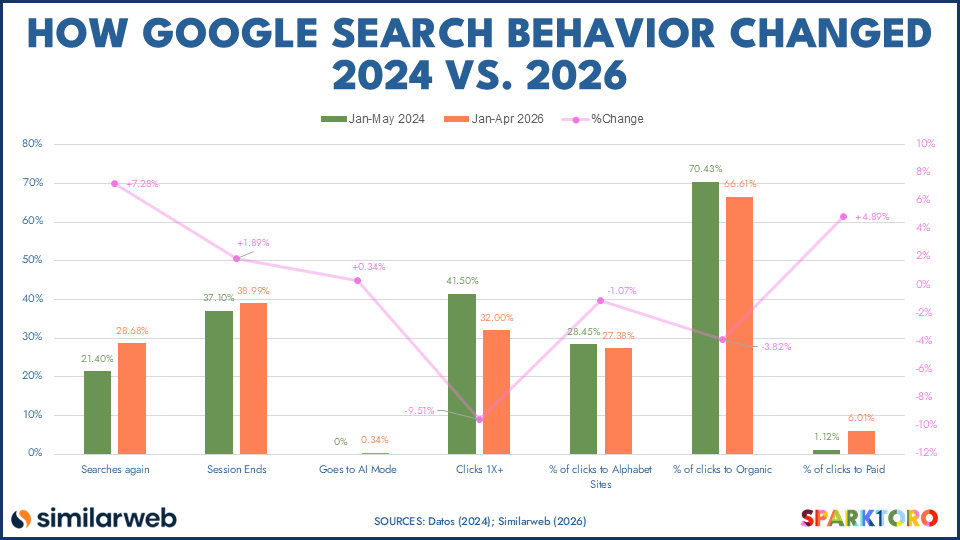
Search is alive and well (Google alone grew ~22%, seeing more than 5 trillion searches, in 2024), so much so that it’s no longer limited to platforms — search is a behavior, and one in five searches happens somewhere other than traditional search engines (like ecommerce, social networks, and AI tools). But the job of SEO has changed. It used to earn you traffic. Now it earns you two different things:
- being the source AI systems quote, and
- capturing the high-intent, ready-to-act searches that still convert — like branded, local, and transactional queries.
Your SEO matters as much as ever, it just won’t earn you traffic the same way it once did. We’ve watched companies where traffic is down and revenue is up (oh hay, HubSpot!).
So how do you “do SEO” now? You focus on distributed demand creation — showing up where your audience already spends time. And you also focus on the other end of that spectrum, demand capture: branded and transactional search, plus a website that converts. “Traffic down, revenue up” only works when that capture end stays strong.
K, so who’s still winning the clicks?
That was my first question too. If Google is keeping two-thirds of searches, somebody is still earning the third that escapes. Who?
Our friend Cyrus Shepard at Zyppy did this homework, analyzing more than 400 winning and losing websites. He found five characteristics that strongly separated the two groups.
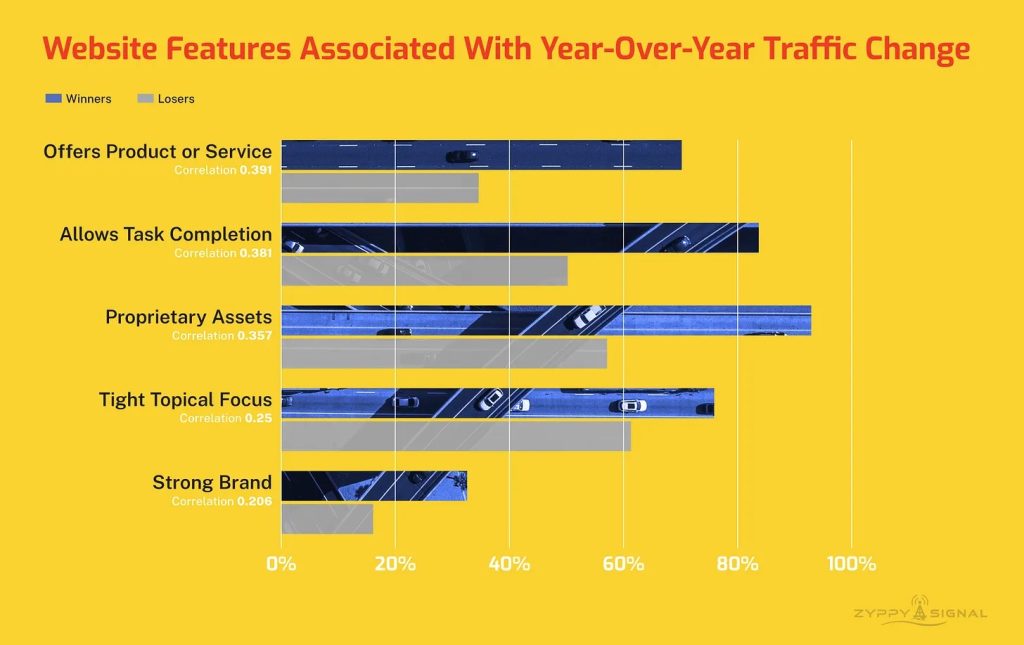
Winners overwhelmingly offer a product or service, own proprietary assets, stay tightly focused on a niche, carry a recognizable brand — and, above all, let you actually complete a task. Nearly 84% of winners let users finish what they came to do, versus half the losers. And “task” doesn’t only mean “buy.” It means run the calculator, check the ticket, practice the math problem, book the appointment. The losing sites were the ones that explain something and then point you elsewhere to act on it — news, pure information, thin affiliate pages. (Think: Byrdie vs. Dermstore, where the former offers skincare product reviews, and the latter offers skincare product reviews and lets you buy these products.) As Cyrus puts it, Google has moved past rewarding “good content” and started rewarding what AI can’t replicate.
The most useful finding, though, is that these features are cumulative. Having only one of those features hardly helps you, as those sites won just 15% of the time. But sites with four or five won around 68 to 70%. So you don’t win by doing one thing well. You win by being a true destination — somewhere a person can finish the job where you own that next step of the journey.
AI isn’t “inevitable.” It’s nuanced.
There’s another thing I fear people will say: “See? AI is inevitable. Might as well accept it now so we don’t get left behind.” I’m not into that. That’s a prediction betting on the current technology to win. And I don’t place bets. I work off of principles. The principle is that online search and discovery have always been mediated by a machine that serves people, and AI is just the most capable version of that. Google has been doing that since its launch in 1998. Social feeds do it too. So does Amazon.
But most people don’t experience this as “using AI.” They go to Google. They open Amazon. They scroll the algorithmically driven Instagram Reels feed. That’s household technology to them — but those are all AI-powered now, influencing what they see and what gets recommended. Nobody opted in for that, yet it’s already sitting between you and your customer.
When people do knowingly reach for AI, they’re at least somewhat discerning. According to an Exploding Topics survey of 1,009 respondents, roughly three in four U.S. shoppers say they’ve used AI to research or buy something — but nearly one in three won’t let it actually spend their money on its own. Respondents’ AI usage included tasks like product research, finding deals, deciding between brands, getting gift ideas, and summarizing customer reviews — not just opening ChatGPT and asking, “What shoes should I buy?” So the machine advises yet the human (still) decides. By the time that machine actually sends someone your way, they land further down the funnel than a typical click.
Adobe found that traffic arriving at U.S. retailers from AI sources grew almost 400% year over year in early 2026 — and once it lands, it converts about 42% better than non-AI traffic, with visitors staying longer and browsing deeper. So even as clicks fall, the machine-referred human is worth more.
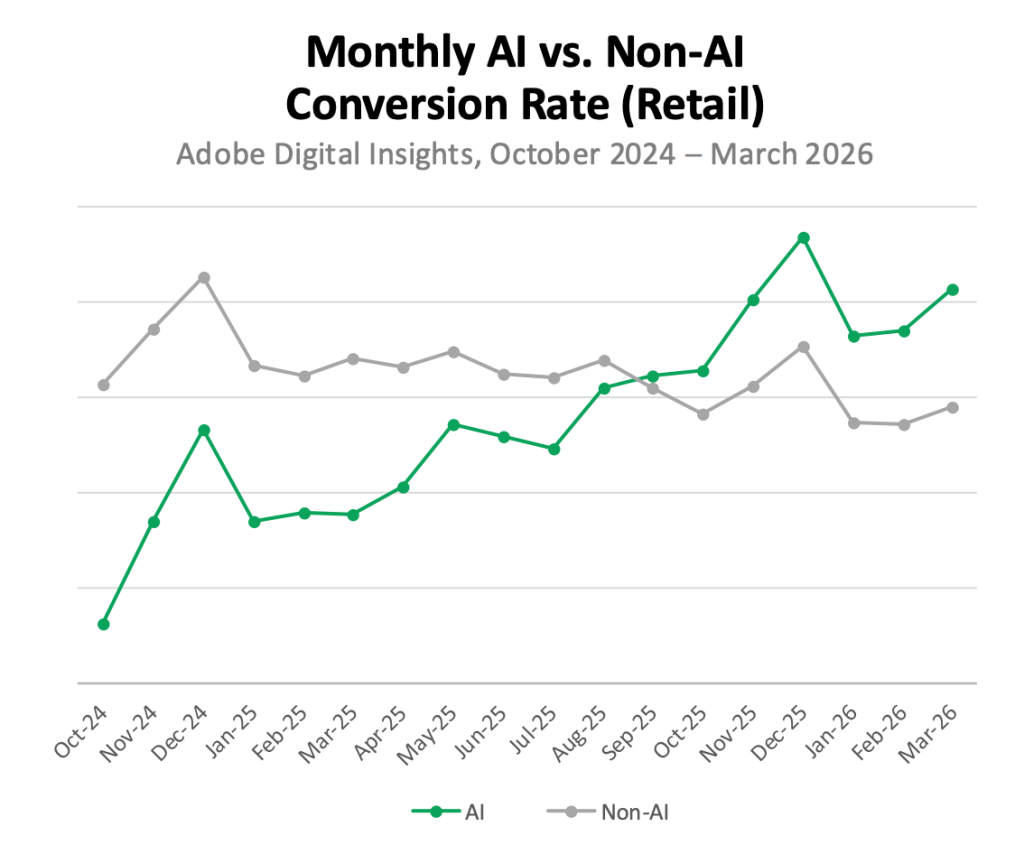
This is exactly why Rand argues you shouldn’t neglect your website even as its traffic falls. You still publish the clear, correct page — not to win the click, but so the machine gets your facts right and quotes you. Your content’s new job is to be the source the machine trusts. If that sounds familiar, it should — it’s the same argument I made a couple months back in If Search Captures Demand, Public Evidence Creates It. Search rarely creates demand. What does create it is the public record — the reviews, the published facts, the third-party mentions a machine reads before it decides whether to mention/recommend/cite you.
And if you think the whole AI wave is a bubble? You might be right. But the behavior — people relying on machines to filter, rank, summarize, and recommend — won’t reverse if the bubble bursts. Even if valuations crater tomorrow, Google and Amazon won’t rip the AI out of the products your customers already open every day. Bet on the behavior, not the hype.
This is the strategy I’d be betting on for the next few years
Ok fine, I said I don’t place bets, but if I had to, it would probably be this:
Make your brand your moat: This is the longest-lasting bet. Always has been. In Cyrus’s data, strong-brand sites (e.g. Mentalfloss) won at roughly twice the rate of everyone else. Branded search still reliably sends clicks (branded terms make up ~44% of Google searches), and AI answers preferentially cite entities they already recognize. Channels churn and algorithms change — but a brand that people and machines look up by name compounds through all of it. Your goal is to become a named entity, not get a bunch of pages to rank.
Own what you can: Done without a long-term plan, doing Zero Click Marketing on rented platforms (i.e. social media) can swap your dependence on Google for a dependence on LinkedIn, Instagram, YouTube, or whatever platform du jour — all of which can change their rules just as easily. So convert that rented attention into assets you control: an email list, a community, first-party data. That owned data is the one thing no platform can revoke.
Measurement > attribution: Retire traffic-as-scoreboard and set up a correlation dashboard instead. Does branded search, direct traffic, and revenue move when you show up where your audience already pays attention? KPIs like branded search volume, social media engagement, share of voice, and audience growth can all serve as proxies for awareness, preference, and demand. It’s unsexy. It’s imperfect. But between dark social hiding referral traffic, arbitrary conversion windows, privacy changes, cookie restrictions, ad blockers, and the simple fact that humans actually bounce around the web like pinballs in a machine, a correlation dashboard is not materially more fictional than the click-based attribution you already trust.
What’s durable — what survives every algorithm update and whatever AI feature Google ships next — is this: show up where your audience already pays attention, and build something inimitable enough that people and machines come looking for you. That’s Zero Click Marketing. (And Zero Click Marketing is now a book, co-authored by the inimitable Rand Fishkin and yours truly. Preorder your copy today and don’t get left behind, bro.)